35 Things for my 35th Year

Maybe it’s a severe case of Youngest Child Syndrome, but I’ve always seen 35 as a significant coming-of-age. I feel like I’ve been leaning toward 35 the way children giddily peer into a pillowcase full of trick-or-treat loot. My birthday came and went this year with moderate fanfare – just the way I like it. My birthday week daydreams were full of wishes, hopes, and prayers (and a few silly wants) for myself and for others. So many things were zooming through my brain that I decided to write them down. Now there’s a record of them and I get to wait and see what happens. Hopefully some really good things.

Here they are in no particular order — 35 things for my 35th year:

1. I want at least 3 memorable cups of coffee — one by the beach, one on a mountain, and one at a cafe while making a new friend.
2. I pray for physical healing for my friend Joni so she can return to the mission field.
3. I want to be surprised by something new God has for me.
4. I wish my feet weren’t two different sizes, or, I hope to find dress shoes that won’t cause apocalyptic blisters.
5. I hope my niece Kennedy stays her spunky, uninhibited self as she grows up. That girl can dance!
6. I pray for my brother Brock’s first year of marriage. For honesty, fun, and affection to be the foundation for their next 50 years.
7. I want to take 5 spontaneous road trips. One of them must be to Yosemite.
8. I hope I get to go to the Olympics in Rio. Who cares if it’s as a volunteer? Pick me, IOC!
9. I pray that this curriculum on the Holy Spirit would take us to deep places in our Bible studies this year.
10. I want to befriend some of my neighbors.
11. I hope that at trip to India is in my future.
12. I wish for rain for California and all the places in the world affected by drought.
13. I want to see C encounter and choose Jesus.
14. I pray I remember to close the garage door when I leave for work.
15. I pray for my brother Brandon’s family as they adjust to their new life in Massachusetts.
16. I want to take an art class, something that uses lots of color.
17. I hope for job security, good health, and a flourishing marriage for my parents.
18. I anticipate many more healthy years for my aunt Caye. That’s one premium kidney my dad gave her!
19. I pray for children in foster care — for the protection of their bodies, hearts and minds — and for the social workers who are searching for their forever families. I pray for generosity in state budgets so the children and social workers have the resources they need.
20. I want to discover four new authors for some good reads.
21. I hope my teaching and preaching will be full of wisdom, helpful illustrations, and a dash of wit. No dull sermons around here!
22. I pray for the single men and women who secretly wonder what is “wrong” with them. By God’s grace, and through caring friendships, I hope they grow in confidence and self-love.
23. I wish I looked my age instead of looking 23. When I’m 50, I better appreciate looking 35, as everyone predicts I will.
24. I want to discover a love for cooking. But since that isn’t likely to happen, I at least hope to hate it less.
25. I pray for all my friends who are new parents — may God bless you with sleep, moments of wonder with your child, a hastily snatched date night, and some good alone time.
26. I want to hold lots of babies this year (and every year), so anyone who wants that alone time, call me!
27. I pray that the church will be a change agent in the injustices of our age, especially in regard to racism, human trafficking, and the exploitation of women and children.
28. I wish that ‘evangelical’ wasn’t such a dirty word in our culture.
29. I hope for dirt cheap airline tickets to Harrisburg, PA. Or better yet, that my besties would move closer to me!
30. I want to be flooded with energy and ideas for writing so this blog will be a meaningful and fruitful place.
31. I pray for the renewed health of the SLW family. May these years of difficulty become an incredible redemption story.
31. I pray I will have a strong sense of family as I develop relationships in my new home.
32. I can’t wait to see what my nieces and nephews do with their lives. I pray that they will know, love, and serve God with joy.
33. I want to laugh a lot. At least once a day. But I would settle for a deep belly laugh once a week.
34. I hope for stable, long-term housing so I can use it as a place of hospitality for the lonely.
35. I pray God would make a way for me to adopt when the time and circumstances are right. That I will be a healthy, wise, and compassionate parent.

A Heart the Size of 12,000 Miles

For the first 18 years of my life I lived in Columbus, Ohio. For 17 of those years I lived in the same house. I attended two churches and three schools in all that time, surrounded by the same people. My parents had a solid and affectionate marriage (unless they attempted a home improvement project together), and I knew very few families affected by divorce or death. My childhood was a picture of stability. 29c4a78abd3f1b0c3e24c1d8b84e94d4 Ohio is a great place. The people are friendly. The housing and groceries are affordable. The weather isn’t unduly harsh in any season; and if you’re a college sports fan, Columbus is Mecca. Ohio is generally so well liked by its inhabitants, that people who grow up there tend to stick around for college. Then they start careers and nurture families there. As a middle schooler, I noticed that no one ever left. Well, that’s a bit of an exaggeration – some went to Carolina beaches for summer vacation, and in extreme cases a Ohioan might go to Indiana or Illinois for college – but everyone seemed destined to boomerang back.

I loved my childhood in the heart-shaped state, but when I pictured my future, I hoped for a bit more variety than the Midwestern suburbs I called home. Even if just for a while, I wanted to fly far away to something new. To experience new smells and flavors, and people with stories different from my own. I wanted my life to be big and vibrant, or at least for a little while, broader and more colorful than the corn and soybean fields that are Ohio’s backyard. So at 18, I chose an adventure.

In a graduating class of 500, I was one of two to choose California for college. I attended a small, private school in a quaint, coastal city. There I met people who used words like stoked and dude in everyday sentences the way I used the words happy and Ben. Girls went to class with bikinis under brand name cutoffs and tank tops; guys wore board shorts, t-shirts, and flip-flops stained with salt and sweat. Everyone looked beach-ready, but in a glossy magazine photo way. I’d never owned a pair of overalls in my life, but next to all the tanned, sleek bodies with their casual sophistication, it was as if every outfit I owned screamed farm girl!

Those four years at the beach were difficult but good for me. Despite my Midwestern-girl-next-door vibe, people were generally friendly and accepting. In California I discovered a love for learning and for the avocado. I learned that seafood is edible and delicious when fresh, that cyn is the abbreviation for canyon (that’s an embarrassing story), and that God wanted me to be a pastor. Even though I felt constantly oafish, that feeling got me to a moment every young woman needs – the moment when you look in the mirror and see yourself for exactly who you are, with all your strange beauty and glorious awkwardness, and you lift your chin and say, “This is who I am. And this is good.” And then you step into the sunshine and live.

Those early years in California helped me realize that life is too short and too important to let comparison or insecurity bridle me. I will probably never be thin. I will probably always laugh a little too loudly. I will continue to be more interested in maintaining my friendships than I am my appearance. I’ll bore people at parties with stories about my nieces and nephews. I’ll occasionally cry at work. I won’t stop myself from being goofy near babies. These are just a few of the things that make me, me. Sticking out in California helped me see myself. Because I felt the love of God shining on me even when I felt awkward, I was able to love myself in all my oafish glory.

That profound movement from insecurity to acceptance made me confident and courageous. It turned me into an adventurer who chooses newness and change, and who embraces discomfort and awkwardness, because those things are markers on a treasure map for the soul.

Though I think of it fondly, I never moved back to Ohio. Since my leap to the left coast, I’ve moved a total of 12,377 miles. I’ve lived at 11 different addresses across 5 states and Canada. I’ve lived in neighborhoods where being white and speaking English made me a minority. I’ve joined churches where standard potluck fare was spam and sushi rather than the chicken casseroles and apple pie of my childhood. I’ve also been able to travel to 18 countries on three continents.

This adventure has enriched me, but not without cost. I now have the eyes to see things like white privilege, poverty, racism, and systemic injustices – domestically and around the world. These are things you can’t unsee. They come with some nasty emotions like anger due to a sense of powerlessness, and a grief so thick it stains like mud. As painful as this descaling of my eyes has been, the good news is that these 12,000+ miles have enlarged my heart. My ability to listen well and be compassionate has expanded along with my worldview. Now I don’t want to only meet and hang out with people like me; that’s comfortable but boring. I’d rather seek out people who are different from me. I want to hear their stories, to laugh with them, to discover what makes them tick, and to have their friendship increase my vision for God’s handiwork.

Each new place, people and culture, has marked me in some way, but none have changed me fundamentally. I’m still Corrie – a friendly, somewhat clumsy, unsophisticated, indoorsy, Midwestern girl – but now I’m layered with other landscapes, stories, and experiences. When I look in a mirror now, I see the same person I was at 18, but there’s a shimmer. Like the moment when colors burst and blend as you slowly turn the barrel of a kaleidoscope, there’s a richness to me that wasn’t there at 18. If you look and listen carefully, you can see it in my gaze and hear it in my laugh.

The best way to learn a new neighborhood is to go out and get lost. Leave the GPS at home and go wander. Walk down a quiet side street or get in the car and take five random turns, just to see where they lead. It’s a little scary to do this, especially in a foreign country, but when you do the feelings of being lost and out-of-place fade quickly. Habitual wandering makes unknown landscapes familiar. And one day you will realize that those unassuming side streets are your best route home.

Sustaining Women Clergy: A Call to Action

Moving to a new state and starting a new job usually drains most of my creative energy. I’ve been butting up against some writer’s block the past few months, but thankfully I was able to get some coherent thoughts on paper last week.

Every once and a while I guest blog elsewhere. Follow this link to my latest contribution to the Biblical Gender Equality blog sponsored my denomination, The Evangelical Covenant Church.

Clergy Types: The Silly and Strange

Clergy Types: The Silly and Strange

Several of my Facebook friends have been sharing a graphic called the beards of ministry. Take a look. It’s pretty funny and full of caricatures that are often true in the church.

I remember looking forward to seminary and to ministering in a church. I had such high hopes for learning, for being challenged intellectually and spiritually. I really wanted to see new fruit in the church and in my life. I never expected to witness the birth of the hipster movement.

(Skinny jeans weren't in yet, but I could have gone to seminary with this guy!)

(Skinny jeans weren’t trendy in the early 2000s, but I could have gone to seminary with this guy!)

At seminary, I was surprised to find men (so many men) wearing corduroy pants, flannel button-downs over graphic t-shirts, and wool hats. Granted, I went to grad school in the pacific northwest, but the weather is not so cold that you must wear this outfit ten months of the year.

At my seminary, the professors often used the verb grapple to describe the Christian life. We were grappling with this arduous spiritual and intellectual journey of following Jesus and being a part of his church. Seminary certainly challenged and stretched me, but the only thing I grappled with was the sight of my fellow students toting sleek Mac laptops in trendy shoulder cases while wearing faded Converse sneakers with holes in the toe.

I knew there would be a plethora of men at seminary, but I didn’t expect to have so much trouble remembering their names. I kid you not — in every class there would be at least five guys named David or Daniel; two guys named after the patriarchs (though Abraham was rare); a Paul and a John or Jonathan; and at least one guy named for a minor prophet. Other than a Jewish synagogue, a Christian seminary is just about the only place you’ll hear a guy introduce himself saying, “Hi, I’m Ezra” and then hear the other guy say, “So am I.”

And yes, the facial hair phenomenon was as real for seminarians as it is for pastors. There were so many strange, but clearly intentional, patches of facial hair. My theory is that creative facial grooming draws the eye away from an exposed scalp. Here is the question I will ask the Lord when I meet him in heaven — why are so many seminarians prematurely balding?

Really, this scalpular creativity is nothing new. My brothers in Christ are carrying on a long-standing tradition among religious men. Soul-patches are just the modern day tonsure.tonsure_statu

Clearly, that graphic about pastoral beards got me laughing about all of the stereotypes I’ve seen in the flesh. But it also got me thinking about the things that I experience as a female pastor in a faith tradition where pastors are mostly men.

For instance, take the robe.

I’m not from a tradition where pastors preach in robes, but Clergy-Roberecently I was asked to wear one for a wedding I’ll be officiating. The only robes I’ve ever worn were rentals definitely made for the male body, though advertised as unisex. There was no room for hips.


The sleeves on these robes are poofy and voluminous – you could fit a small child through their opening. So I had a pastoral dilemma of needing a robe, but as a woman I also had a style dilemma; I did not want to drape myself in a manish, gospel choir inspired robe.

Thank goodness I found this flattering and feminine robe courtesy of the staff at Women Spirit.

“Ruth” robe

Clothing and hair are also an issue for the female pastor, especially when preaching. Most churches either supply mics that clip on your shirt like this…

clip-to-shirt
or on a tie, like this…

lapel mic
or one that hooks around your ear like this…

wireless-microphone-5
As a woman, I have issues with all of these options. First, when preaching, I do not wear button down shirts as a rule. This eliminates the risk of unfortunate gapage during Spirit-filled hand gestures.

Second, I’m not in the habit of wearing a tie or a stole to which I can conveniently clip a mic. I won’t be wearing a tie. Ever.

Third, those over-the-ear mics can be a problem for those of us with small ears or long hair. Every time I preach, our sound technician bends the earpiece like Gumby’s legs, desperately trying to fit it to my ear. He always ends up taping the thing to my cheek and the cord to my neck. When I wear my hair down, he instructs me to avoid moving my head so my hair won’t brush the mic and cause crackling.

You try preaching two half-hour sermons without moving your head. Especially when there is tape on your face.

Also, I’d like you to try preaching from a pulpit designed for the average man. I’m four inches taller than the average woman so this is less of a problem for me, but many of my female counterparts are preaching at pulpits much too tall for them. The flat surface for notes is closer to their necks than their waists. Natural hand gestures get lost behind the pulpit and the preacher sometimes looks like a disembodied head.

I don’t spend much time thinking about leaving a legacy in ministry. I hope to be known as a pastor who clearly and joyfully preached the good news of the kingdom of God. But I have this funny feeling I’ll be remembered for something insignificant, like being the pastor who invented the first height-adjustable pulpit. I guess there are worse things to be known for…

soulpatch

Like Peter: Following Jesus on Good Friday

I’m working with our worship pastor to shape our Good Friday service. We are using a series of dramatic readings, shaped from the Gospel of John, to tell the story of Christ’s last days. I was looking for a responsive reading that would work well after Peter’s denial of Jesus in John 18:15-27. Despite many online resources, I couldn’t seem to find what I was looking for. So I created something new, borrowing from something old.

This responsive reading is simply built; it’s snippets of conversation between Jesus and Peter, taken from all four gospels. It’s designed so that the congregation walks in Peter’s sandals as he follows Jesus. In one minute, the reading reflects three years of discipleship. I want the congregation to connect with the idea that we are all like Peter. Our lives are full of moments of passionate belief followed by doubt, fear, confusion, and passionate denial. You are welcome to use this as you will.

St. Peter in Penitence, El Greco, 1580s

St. Peter in Penitence, El Greco, 1580s

Leader:     Follow me, and I will make you fish for people.

People:    I will follow you.

Leader:     Who do you say that I am?

People:    You are the Messiah, the Son of the living God!

Leader:     No one can come to me unless it is granted by the Father. Will you go away like the others?

People:    Lord, to whom would we go? You have the words of eternal life.

Leader:     I must wash your feet.

People:    Lord, you shall never wash my feet.

Leader:     If I do not wash you, you have no share with me.

People:    Lord, not just my feet – wash my hands and head too!

Leader:     I must go to Jerusalem, suffer many things, be killed and raised on the third day.

People:    No, Lord! This will never happen to you!

Leader:     If anyone wants to come with me, you must deny yourself, take up your cross, and follow me.

People:    I will follow you. I will lay down my life for you.

Leader:     Tonight all of you will run away because of me.

People:    Even if everyone runs away because of you, I will never run away!

Leader:     Before the rooster crows, you will deny me three times.

People:    Even if I have to die with you, I will never deny you!

[pause]

Leader:     Weren’t you with Jesus the Galilean?

People:    I don’t know what you mean.

Leader:     Yes, you are with Jesus of Nazareth!

People:    I don’t know the man.

Leader:     I am sure you are one of his disciples.

People:    I am not!

Spit It Out: Thoughts on Writing

blank docI’ve been working on a single blog post for two weeks. It’s on a topic that’s very important to me, something central to my understanding of God, the church and the world. It’s also a pretty vulnerable piece, so I’ve been working and reworking my words, trying to articulate myself well. I’m growing more frustrated by the day because I have something important to say, but I can’t seem to spit it out.

I took a creative writing course in graduate school. Each week we had to submit a 500 word piece and share it with a small group of classmates for critique. My peers often said that they liked what I wrote. They complimented my sentence structure and my use of imagery and metaphor, but they always seemed to withhold something in their feedback. I didn’t know what it was then, but I do now.

I was missing substance.

I wrote a piece about a fly for that creative writing class. I wrote long and eloquently about an ordinary fly that flylanded on my desk during an afternoon lecture. The fly was uncommonly still, so I studied it closely. This was somehow fascinating to me, and noteworthy enough, I felt, to share with others. I described the fly’s antenna, the translucent beauty of its wings, its large onyx eyes, and its knees. Its knees! I’d noticed for the first time that flies have “legs” that seem to bend in the middle, and I wrote an entire page about this phenomena. (That’s so embarrassing.) I think the fly would have been satisfied with my attentiveness and awe-inspired descriptions, but my professor certainly wasn’t. She too complimented my writing ability and then gave me a B. That whole semester, she only ever gave me a B.
My professor clearly wanted more from me. She wanted me to move beyond my ability to use words to shape images. She wanted to know me through my words. She wanted to hear my voice slash across the page, impassioned. She wanted me to stop playing in the verbal sandbox, to gather up all of my words and my creativity with my soul, and build something solid and true.

She was right to want that from me, I just wasn’t ready.

When I started seminary, I was 22 and the youngest student at the school. I was competent, I loved learning, and I was engaged in the classroom, but I also held back. I didn’t speak up too often in class. I had big questions and well-formed opinions, but I didn’t share them in public, only in small groups of trusted friends. I had a voice, but I wasn’t ready to use it. I had substance, but I didn’t feel safe sharing it.

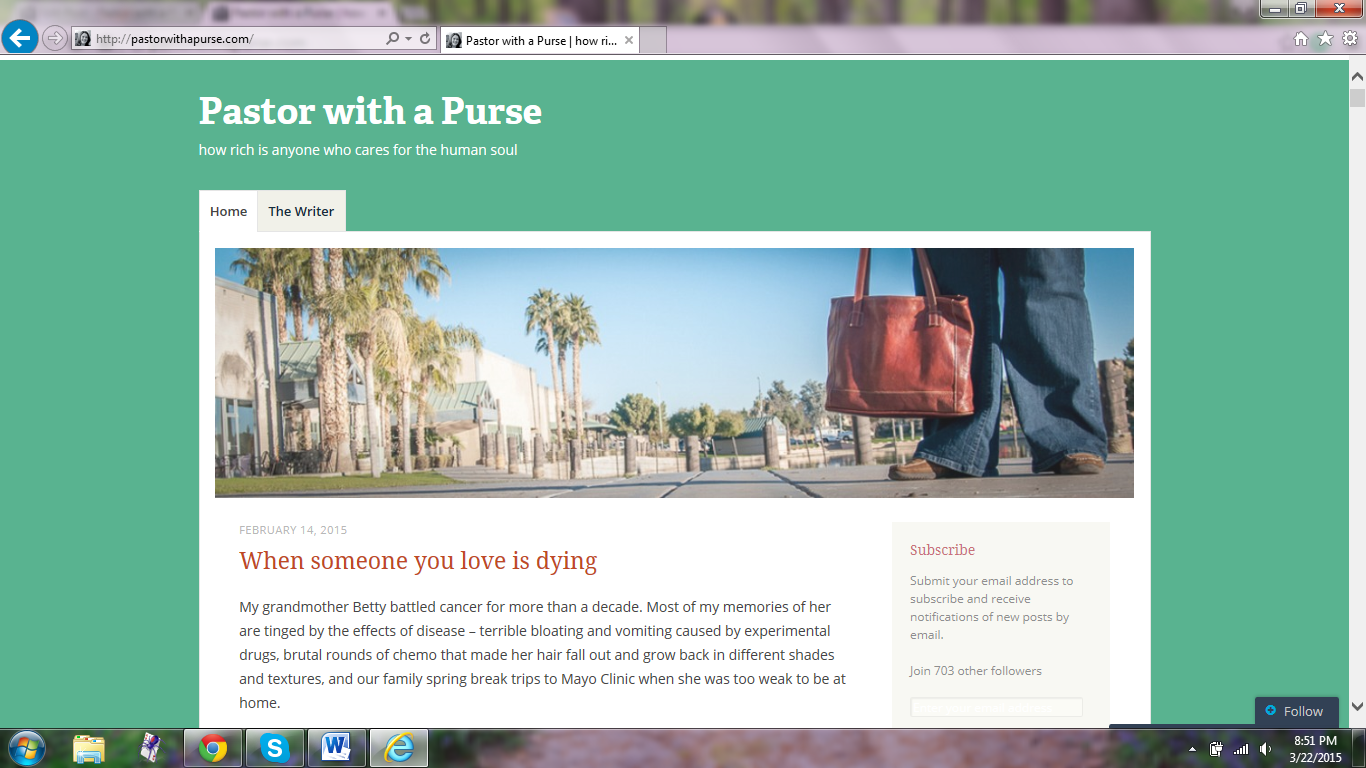
Over the years people kept telling me that I had a gift for writing. They encouraged me to write more and to share it with them. In the fall of 2009, I started this blog, which I called “The Purse” because of a funny, teenage anecdote involving my mother. It was an experiment in using my gift to use my voice. I thought if I told a few friends and family about the blog, that would keep me accountable. A familiar and caring audience would be the gentle pressure I needed to spit myself out on paper. I hoped to be clear and honest. To write well and to grow as a writer. To talk about things that mattered and ask important questions. But most of all, I wanted to take up my voice and have the courage to share it with the world.

Five and a half years later, I know I’ve accomplished all of that (though my use of punctuation still needs improvement). My little experiment in voice development is now a vital place of personal reflection. I’m a verbal processor, but I hate journaling. This blog is my forum. It’s where I talk out my thoughts and questions until they line up into something life-giving. Gradually, it’s become a place safe enough for me to share my pain, doubts, and struggles.

blog screen shot

I’ve put my soul in these posts, and it’s out there for the world to see. I now have over 700 subscribers, most of whom are strangers. That’s a modest number in the world of blogging, but I’m not hoping to quit my day-job. I’m just astounded that 700 people want to hear what I have to say on whatever topic I choose.

Despite my expanded audience, this blog continues to be something profound for me. I’m shaping, sharpening and sharing my thoughts, beliefs, and my faith with every word I write. Some posts are better than others, but I think my voice is coming through, confident and clear.

I know myself better than I did in 2009. The name change from “The Purse” to “Pastor with a Purse” is evidence of my growing self-awareness and a clarity of purpose. I know who I am. I’m using my voice. And I’m offering substance from my soul to the world. Now I have a new problem. I have important things to share and in my head I know what I want to say, but I can’t seem to harness my words.

That’s all I wanted to say, really. I just needed to set aside my angst over the post that I can’t seem to get out, and just write. Now, I also want to say how grateful I am to God for this blog. What an incredible adventure this has been, to open myself up to more than just a few trusted friends and share my soul with anyone who wants to listen.

Thanks too, to my original twenty readers, those friends who encouraged me to write in the first place. You’ve helped me grow up and keep growing.

And I guess, while I’m at it, I should also thank my creative writing professor for all of the B’s she gave me. She showed me that I wasn’t using my greatest tool in writing — myself. I think if she could see how far I’ve come from that fly piece, she would be proud. She may even give me an A for all this substance.

When someone you love is dying

My grandmother Betty battled cancer for more than a decade. Most of my memories of her are tinged by the effects of disease – terrible bloating and vomiting caused by experimental drugs, brutal rounds of chemo that made her hair fall out and grow back in different shades and textures, and our family spring break trips to Mayo Clinic when she was too weak to be at home.

Despite her prolonged illness, I remember many good things too. Grandma’s nickname was Mean Betty Jean but she was just the opposite: invariably kind and calm, with a gentle smile and a friendly chuckle that made me want to cuddle into her side. She taught me how to play card games like Crazy Eights and Kings in the Corners. Every year for Christmas, she bought me pajamas that came packaged with a matching stuffed animal; this was both delightful and silly.

Even though my grandmother was sick my entire childhood, I never realized that she was slowly dying. One ordinary Thursday I came home from school, made myself a snack and was eating it standing by the sink when my mom came in and told me that grandma had died. We stood there for a long time, quietly crying by the kitchen sink. I thought I’d share many more spring breaks with grandma. I was looking forward to another Crazy Eights tournament. But most of all, I wished I’d had the chance to say goodbye and to give her the best hug I had because I knew it would be our last.

Now in my mid-thirties, I’ve said goodbye to several beloved family members and friends. As a hospital and hospice chaplain, I helped people prepare for death and supported grieving families. With death and dying as the landscape of my daily work, I learned that while being a witness of death is never easy, it doesn’t have to be depressing or scary.

The time that precedes death can be the most beautiful time you share with someone you love. It’s a time to give and receive precious gifts. Not gems set in velvet boxes, but true words and actions. Things as simple and life-giving as presence, as saying I love you, as laughing over a hand of cards. These are gifts with the power to free souls from fear and pain and open them to gratitude and joy.

If your loved one is dying – my thoughts are with you. I pray you have the courage to give and receive the following gifts.

Talk about death. We often avoid the D-words – die, death, dying – because we fear it will be too painful for the one who is dying. In my professional experience, dying people want to talk about death. Unless they suffer from dementia, they know it’s their daily reality. Most want to acknowledge it, talk about it and prepare for it as best they can. They want the opportunity to review their lives, tell their stories, to confess their regrets, and seek forgiveness. How will they have a chance to do this important work, this emotional preparation, if we are afraid to accept their reality? One of the greatest gifts you can give your loved one is the freedom to openly face their death.

Know and honor their wishes. Terminal illness comes with an obstacle course of decisions. Do we pursue life-extending medical treatments? Will we manage the pain with narcotics or alternative therapies? What finances do we need to get in order? When and how should we prepare the memorial service? These are important questions, but too often families tackle them without consulting their loved one. Two of the greatest emotional struggles of the dying are loss of control and loss of identity. Asking your loved one about their wishes, and following through with them, honors their personhood. It helps them retain an important strand of control. Start with Five Wishes and advance directives.

Address the bucket list. People who are dying often daydream about what they would do if they had unlimited time and resources. For many, this ‘bucket list’ may not be written on paper, so talk to your loved one about what they want to do with their remaining time. Many bucket list items can be accomplished outright but you might need to do the legwork. Other items might be beyond your loved one’s physical capabilities, but could be modified to achieve the same sense of satisfaction.

Consider hospice. While hospitals do what they can to create a comfortable environment, it’s not an ideal place to share your final days. Hospice provides 24-hour on-call support for patients and families in a variety of settings: private homes, retirement communities, skilled nursing facilities, and in-patient hospice units. It is a free benefit of Medicare, Medicaid (in 47 states) and of most private insurance carriers. A consistent, interdisciplinary care team – including a physician, nurses, a social worker, and a spiritual care provider – will manage medications, address pain, provide informed and compassionate guidance as things change, and generally enhance your loved one’s quality of life. Not all hospices offer the same range of services, so ask for referrals in your area. If you have more questions, start here.

Share simple pleasures. It’s easy to get distracted by all the details that come with caring for a loved one. Meetings with lawyers and ministers are important, but no more so than surrounding your loved one with what gives life to their soul. Focus on simple things. Cook their favorite meal, even if they can only enjoy a few bites or the smell. Hold hands. Reminisce and tell your loved one why you cherish them. Say I love you. Put a cozy lounge chair in the garden and share the sunshine and the quiet. Have a family movie night. Read their favorite stories aloud. Let the grandkids star in a family concert or play. This will be their comfort and joy.

Let them apologize. It’s natural to seek forgiveness and express regret at the end of life. Research shows that the dying seek forgiveness in three categories: the forgiveness of God, of others and of self. Surprisingly, the data says that forgiveness of self is the most difficult category. Seeking the forgiveness of others is certainly a doorway to forgiving ourselves. Families often try to deflect, minimize or avoid such apologies because they don’t want their loved one to feel burdened by grief. Well friends, grief is unavoidable at this point. The good news is that letting your loved one speak their truth is precisely the thing that can lighten their burdens. So when they speak, don’t interrupt. Take deep breaths and listen until they are finished. Then offer words of acceptance and love.

Let yourself be weak. If I had a dollar for every time I heard a family member say I have to be strong… I know this is difficult advice, but it’s much kinder to let yourself fall apart from time to time. Have a good cry in the shower. Go into the basement or the woods and yell. Confess your fears and struggles to a good friend or counselor. Cry out before God. These are better coping skills than trying to rigidly harness the emotions that come with losing someone you love. Grief is an unruly thing; it comes and goes in unpredictable, sometimes turbulent, waves. Try though we might, the tide is not something we can control. It’s best to ride the cresting waves and trust that they will deposit you on shore.

Care for yourself. It’s okay to care for yourself even when your loved one is dying. In fact, it’s critical. Stress and grief will upset your ability to assess your needs, so listen to your friends and family when they say you need a break. Let them take you out for coffee or to the spa. Accept their casseroles, their offers to clean your house and their long hugs. These things are like a good saline drip to a body parched from grief. Plus, it will give them a practical way to help you, which is what they desperately want to do.

Plan a memorial service. This part of the grieving process can be difficult, but also incredibly healing. Through words, music, prayers, pictures, flowers and food you can craft a gathering that honors the life of your loved one. Invite family and friends to contribute and do the work together. You’ll laugh and cry and discover later that this is when the mending began.

Stay connected to God. Friends, this is the time for raw and real prayers. This is a time to use the Psalms like prayers when you have no words of your own. This is a time to sit on the floor in your closet and open your hands to heaven. It’s a time to acknowledge your weakness. To ask for comfort and for the strength for one more day together. It’s a time to realize that God is in every moment working for your good and for the good of your loved one. And when pain, fear, and confusion come, this is when you’ll need to trust that things are not as they seem. Remember that God is with you, doing the unseen, gathering you all under the shadow of his wings.


Have mercy on me, my God, have mercy on me,
    for in you I take refuge.
I will take refuge in the shadow of your wings
    until the disaster has passed.
Psalm 57:1

New Year’s Reclamations – 2015

In the past two weeks I’ve moved away from Hawaii, celebrated Christmas in Phoenix, bought a car and moved to California. It’s been 11 days of constant motion, packing and unpacking, traffic, goodbyes and hellos. So yesterday I took my Sabbath and went out exploring with no particular agenda. I ended up at the largest Starbucks I’ve ever seen and bought a latte. As I waited for my coffee, I noticed that every single person filling the twenty-odd tables had some kind of screen in front of them. People were sharing tables but no one was talking, making eye-contact, or smiling. It struck me as odd, for a room to be so full but so devoid of life.

I grabbed my latte and went to sit outside in the sunshine. For thirty minutes I watched the parking lot bustle with activity. Drivers zoomed in and out of parking spaces with the nonchalance of stuntmen. They took corners like NASCAR drivers and I feared for the lives of pedestrians weaving toward their cars. Between bouts of fear, I finally had time to think about the new year and all the opportunities ahead.

I’ve never been into New Year’s resolutions. I’m naturally suspicious of trends and resist doing things just because scads of other people do them. I think it’s healthy to do some inner housekeeping and improve habits, I just wish resolutions didn’t come with a side of shame. I want to do things because I truly want to do them, not because someone or something has made me feel bad about myself. So instead of resolutions I likely won’t keep, I’m making a list of reclamations – practices I believe in, things that I can lean into in any way, and at any pace, I choose. With reclamations there’s no pressure of quick mastery, no measuring stick for success and no quotas. It’s just me inviting myself to pursue positive, meaningful things with a spirit of curiosity, hope and freedom. So here are my reclamations for 2015…

FACE TO FACE TIME – Screens are everywhere: tablets, smartphones, video games, and e-readers fill our hands. TVs have taken the place of art in waiting rooms, restaurants, and church lobbies. I’ve even seen TVs at the gas pump, in elevators and some public restrooms! While these devices can offer important information, entertainment and even some quality educational programs, they also snatch away my attention from living, breathing, human beings.

girls on their phone

When was the last time you had a conversation with a friend or loved one without distraction? A meal or date night without texts read and answered? Family time that excludes scrolling through your Facebook feed? Actual words with friends rather than a scrabble game online? These are distractions that we choose over building and maintaining emotional intimacy with our loved ones. We choose screens over souls.

I choose screens over souls.

The more we look at screens rather than faces, I fear we will lose our ability to inspire each other to change and grow, to notice when we’ve hurt someone and seek forgiveness, to mourn together and to celebrate well, to get each other through the hard times and the doldrums. I want real connections with real people rather than sitcom characters. I want to read a friend’s facial expressions, to notice if they look tired or anxious, to offer them encouragement with my eyes as well as my words. If I want to reclaim connections with people, I have to rethink screen time.

Realistically, I know that screens are here to stay. I’m not starting a screen rebellion or going cold turkey with my electronics, but I do want to bring the wisdom of self-control to my screen time. I hope to thoughtfully create screen boundaries that will promote and preserve my relational and emotional health.

LIFE AT SANDALS PACE – Being back in California after living in Hawaii is a shock to the system. I went to college here, but I’d forgotten the hurried pace at which Californians move. Highway driving here can be downright scary – honking horns, wild lane changes, people intentionally cutting people off. Yesterday’s Starbucks parking lot was over-stimulating. Even as I sat drinking my coffee with nowhere to go, I couldn’t completely relax with everyone clipping along.

In contrast, Hawaiians seem to move with the gentle flow of the wind. Everything seems to meander in the tropics: traffic, work, people, turtles. Drivers are extremely courteous and always wait for pedestrians. Meetings start on “Hawaii time” – that’s like saying Africa time, or late – because you’re expected to pause and greet and maybe even catch up with the people you see on your way to the meeting.

No one seems to rush in Hawaii except paramedics. No one runs between 16 different activities. (To run in sandals is to risk your life, as every adult knows.) There’s always time to take the long way because it’s scenic, to point out a rainbow, to go to the beach, bury your feet in the sand and watch the sunset. Not all islanders live this way, but this sandals pace is a choice just like any other.

sandals

As I settle back into life in California, I want to live at a Hawaiian pace. I’ll try to keep my schedule from getting too full so the time I spend with people is unhurried. So I can be attentive. So Sabbath won’t be an adrenaline crash.

DO A WHAT-WHAT – Once a week as a school chaplain I served lunch to the 1st graders. One day, three of the girls were randomly touching their fingertips together above their heads like ballerinas in fifth position. They caught me looking at them, so I winked and mimicked them. They giggled and suddenly it became a game. They’d put up their arms and I’d improvise a little dance in the food line.fifth position

One of the girls asked me what I was doing. I responded, “What does it look like I’m doing?” She said, “Being silly!” Another girl piped in, “You’re doing a what-what!” Clearly that was new to me, so she added, “A what-what is something fun and new you make up. It’s something you’ve never done before and maybe no one will ever do again.” (How cute are six-year-olds?!)

During my seven months in Hawaii we had two hurricanes blow through. Both were downgraded to tropical storms before they hit Oahu, but we still had to stay inside for a few days. Before the rains came, I went shopping for supplies. When I discovered there wasn’t a flashlight left on the island, I wandered into Barnes & Noble. I bought two jigsaw puzzles, a sketchbook, and a hug set of colored pencils.

I’ve never taken a drawing class in my life. I can’t even remember the last time I tried to draw something with any serious concentration, but I surprised myself by spending hours attempting to draw a turkey. (Thanksgiving was coming.) I looked up some pictures on the internet and then did a what-what on paper. It was an experiment in shape and color and blending. I had no idea what I was doing or how it would turn out, but that didn’t matter. It was new, intuitive, playful, and full of freedom. I shocked myself to discover that I can draw something that looks real.  My what-what turkey may not be gallery worthy, but I’d say it’s pretty good for a newbie.

Turkey

I want to reclaim creativity in 2015. I want to feel again the pleasure of surprising myself with a skill I didn’t know I had, to fold new experiences into the every-day and expected.

So here I am, four days into a new year, ready to live more free, to be more attentive, more playful. I’m hoping to take the long way, to meander and make time for creativity on my way to some really great discoveries.