Seeking the Shepherd’s Heart: A Call for Empathy to Men in Ministry

woman_at_the_well2

Not long ago my father talked to a prominent pastor who also leads a seminary. The seminary’s branding is all about having a shepherd’s heart, encouraging students to emulate the Good Shepherd, Jesus. Somehow my father and this pastor came to the topic of women in ministry and the theology that separates egalitarians and complementarians. Dad shared some of the struggles I’ve encountered being a woman in ministry. The pastor responded with, “I don’t mind when people have [egalitarian] views, I just don’t like it when they get angry about it.”

When my father relayed the conversation, I asked him to repeat it several times. A few days later, I questioned him for exact wording. I didn’t want to make assumptions or emotional responses based upon them. When it was clear that this was the pastor’s actual statement, I let myself feel fully the disappointment and frustration that I had been holding back.

One of the most difficult things about being a female pastor is the lack of compassion I see among Christian men, especially pastors. I’ve lost count of the times I’ve heard men give these responses to the topic of women in ministry:

“This isn’t my issue.”

“This isn’t a primary theological issue.”

“This isn’t a salvation issue.”

“I don’t know why they get emotional about it.”

“I just don’t like it when they get angry about it.”

These sentences are usually followed by one of two responses. The speakers either shrug, frown slightly and politely turn the conversation to a different subject or they begin quoting isolated verses from scripture and very pointedly ask, “Well, what do you do with this verse?” The tone that is used unmistakably implies that a female pastor’s vocation can be nullified by theology that hinges on a single sentence from 1 Corinthians or Timothy.

This post is not a theological foundation for women in ministry. Instead, this is a plea to influential men in the church, to elders and leaders and pastors who believe women are NOT called to ministry in the same way as men. Will you please take three minutes to read this post in its entirety?

My plea begins with a question. As shepherds of God’s flock — as called, gifted and appointed leaders of the church — do you believe that empathy should be a part of your leadership?

We all probably know or have served under excellent leaders. In my opinion, the best leaders are those who are quick to listen and slow to offer their own opinion. Excellent leaders never use their opinion or beliefs as a weapon against another person.

The pastors I admire the most are those who solicit the stories and experiences of people different from themselves. They earn my respect because their actions reflect that of the Good Shepherd. Jesus was a leader who ushered angry, frustrated, misunderstood and hurting people — even his enemies — not onto the stage for a debate or between the ropes of a boxing ring but to a table where they could share a meal. Sitting face to face, breaking bread and sharing wine and stories, Jesus had ample space and time to listen well. Across a table he could watch their faces, the theater of human emotions. The ministry of Jesus was fearless engagement, patient listening and compassionate conversation.

Return with me to the topic of women in ministry and consider a few more questions. To disregard, to show apathy, to minimize or to go on the verbal offensive when one (or many) of your flock holds a different theological viewpoint from your own — are these the actions of a good shepherd? Is this showing empathy like Jesus? Unfortunately, what I have encountered, first as a faithful church-goer and later as a woman in ministry, very often falls far short of Jesus’ example.

From childhood until age 26, every pastor I encountered was male. I grew up in a wide-spread evangelical denomination whose global missionary work is noted in church history books. I went to a non-denominational Christian college and a trans-denominational Christian graduate school, both evangelical and highly respected by people across the theological spectrum. I earned a B.A. in Biblical Studies and a Master of Divinity. In these programs men were the majority among both students and professors. I now serve in a denomination that has been ordaining women since the 1970s but the local churches rarely hire pastors from the large pool of licensed and ordained female candidates. All that to say, I know what I’m talking about. I have a testimony about women in ministry and my testimony is true. My story and experiences parallel those of so many evangelical women in ministry, so I invite you to read the following as a trustworthy generalization.

Since childhood, I have seen and heard of the great work God is doing through female missionaries the world over. They are giving voice to the oppressed, rescuing women and children from sexual slavery, planting and strengthening churches and preaching the gospel. But when these women come home on furlough, many of them are not called pastor by the churches that support them financially. They can “share their testimony” on Sunday morning but they are not permitted to “preach.” They may lead a church in Africa or Asia or South America where the gospel is spreading like only good news can, but many denominations would never allow them to do so in the United States.

During seminary I interned at a small church. The leadership of this church gave me complete freedom to develop and lead a ministry to our young adults, a demographic which made up 70% of our congregation. During my second year, I was joined by another female and two males interns. On our orientation day, the pastor announced secondary responsibilities for each of us. The male interns were expected to preach once a semester. We females were expected to oversee the hospitality ministry, which meant preparing coffee and cinnamon buns, passing out welcome bags on Sundays, and organizing monthly potlucks. I assure you that these responsibilities had nothing to do with the spiritual gifts of the four individuals.

“Women in ministry” is a hot topic in colleges, seminaries and churches around the country, in many denominations. We’ve labeled this a controversy, a debate or an issue but it is much more significant than these labels. It’s more significant because it concerns flesh and blood people, women who, like you, are created in the image of God. These women make up half the church.

I imagine that you believe that women have vital spiritual gifts, given by God. You probably even believe that women are your co-heralds and co-agents of God’s mercy, love, justice and peace on earth. Have you ever considered what would happen if you told all the women in your congregation that because of their gender, they cannot use their gifts (no matter the gift) in or for the church? What would happen to the spirit of your congregation? The vibrancy of your mission? Your ability to impact your community? Your numbers?

Have you ever had someone walk up to you and tell you are sinning because you, a man, have preached from the Word of God?

Have you ever considered what it would feel like to have people in a church whisper about you and the scandal you have created by asking to preach the good news to a congregation you know and love and have faithfully served? Have you ever been made to feel like a Jezebel when you asked to share the message of hope to the depressed, to pass real peace to the world-weary, and speak truth to the thirsty? I have.

Men, you are absolutely right when you say that women in ministry is not your issue. It is our issue. It is not exclusively a male issue or a female issue, it is a church issue. This is an important topic for all people of God because once we were all sinners. At the same moment and by the same blood men and women were cleansed and wholly forgiven of their sin. We were adopted by God and now we are a family. We are one body, the body of Christ, and as members of this body we are all fully redeemed and equally essential to carry out God’s mission on earth.

Brothers in ministry, when you fail to engage in this conversation or you only want to debate egalitarians into a rhetorical corner, you make us feel like opponents or enemies rather than siblings, friends or even welcomed strangers. Facing either dismissiveness or aggressiveness, why should people be surprised when we get defensive or emotional in response?

When men say they don’t understand why we get emotional about this “issue” or don’t like it when we get angry, they shame us for our emotions. (This may not be the intention, but it is the effect.) But aren’t we all — women and men — emotional beings, created as such by God?

A wise man taught me that emotions are the windows of the soul. As a counselor I’ve learned that heightened emotions like anger and tears are flags that mark deeper fields to be mined. That is why I was discouraged and frustrated by the response of the prominent pastor from my initial story. Here again is another man who, though he is called pastor and respected as the shepherd of thousands of believers, fails to realize that his way of leading causes pain to so many.

I promise you brothers, that if you ask an angry or otherwise emotional woman about her emotions, if you patiently and gently dig a little deeper, you’ll inevitably unearth red-hot pain. For women in the church, pain is the natural result of being told or shown a hundred different ways since childhood that you are untrustworthy because you are female. Anger is an understandable and justified emotional response to being treated like the second-class saved.

The second-class saved. That is who we feel like when you affirm our gifts and our important role in the church and with the same mouth you say that because we are women we cannot preach, teach men or be pastors. It hurts. It’s confusing and contradictory. Theology which restricts women from any pro-gospel actions and the force with which you defend such theology sends a strong message that women are not really fully redeemed. There are few messages that are as painful to receive as this one.

Brothers, you may never believe what I believe about the calling of women to lead the church. You may never verbally affirm the excellent leadership of women in your congregation but will you listen to us?

Will you try to comprehend that your theology, how you present your theology and how you lead your church may cause pain to women in your congregation?

Will you consider life and theology from a perspective not your own?

Will you take the time to imagine what it is like to receive the gospel as one of the persecuted or oppressed rather than the privileged?

Will you sit at tables with us and ask us to share our stories?

Will you shepherd as Jesus did, with empathy?

A Letter A Day: Reflections on Lent & Love

ImageI’ve been meaning to report on my practice of Lent this year but time has blown by lately like a desert monsoon. (I started a new job in mid-March and I reserve most of my free-time for brain recovery.)

A love letter a day. I loved the idea and for much of the season, I enjoyed the discipline. However, I bumped again into one of my weaknesses: I’ve never been good at doing what’s best for me every day.

I find time to read fiction 1-2 hours a day and it is of some value. Exercise, reading scripture, prayer — these are of higher value and yet I struggle to make them part of my daily life. Even excited to write these Lent letters, there were days I had to pull out my calendar and count boxes to know how many letters I needed to write to catch up.

The major benefit of writing to so many of my beloveds? I was constantly reminded to offer myself the grace and love that I show others. I forgave myself the skipped days and focused on enjoying the hours spent with pen, stationary and warm memories.

The picture above is my final stack of love letters before I stuck on Forever stamps and sent them across the globe. The easiest part of this whole practice was deciding to whom I should write. Composing these letters often slipped into times of praise and thankfulness for the many cherished memories and relationships I’ve formed over the years. I wrote to each of my 7 nieces and nephews, to my siblings, parents, some extended family, many former college students whom I mentored, and friends from every stage of life.

I wrote to my mentor from high school, thanking her for showering me with unconditional time and love. I credit her gentle and considerate presence in my life as one of the major reasons that I have an authentic faith in Christ today.

I wrote to my friend and former roommate Joni who is a long-term missionary. She recently moved to Madrid and despite debilitating chronic pain from scoliosis, Joni lives with such joy and purpose. Since meeting her in 1999, she has inspired me to take risks and to push against the boundaries of what I think God can accomplish through my ministry.

Secrets and trust were themes in many of the letters. I wrote to several friends about secrets shared and released. I met Karen at a time when I held many things tightly and fearfully inside me. Openly and honestly Karen shared a personal struggle with me, which enabled me to trust her with my stuff. By example, Karen ushered me trust again. Writing to Karen sparked a second letter to a friend who last year broke silence to me regarding a life-long struggle. I wrote thanking her again for trusting me with her pain. I sealed the second letter realizing that have become a safe place for others because Karen was first a safe place for me.

I sent Lent letters to more than 15 states. Three went to Canada; a few to Europe. The youngest recipient was my niece Kherington, who, at age 3, got a few silly jokes her mother will have to read to her and a terrible drawing of a cat.

Some letters remain on my bookshelf, stampless. There are 5 written to God, labeled with different names of God depending on the nature of the letter. I sent those through a prayer office rather than a post office.

There’s a letter written to a friend whom I’ve lost contact with, but for whom I pray regularly. Over the past two years I have asked for his new address via Facebook and email. He has not responded. My concern that I caused him pain is the very reason I wrote. I hope he will allow me to make amends. I’ll hang on to his letter with hope.

I never wrote the letter to my former sister-in-law. I stared at many blank notes intended for her. In the end it was too difficult to write, too charged. I chose instead to pray for her, for us, for all whose lives were forever changed by her actions.

To Corrie, July 1st, 2017 — this is the label of the letter I wrote to myself in 5 years. I’ve spent a lot of time in these tumultuous three years praying and thinking about the woman I want to become. I’m not looking for a brand new me but a Corrie who is renewing, refined, purposeful.  This letter had several lines of celebration for the real and far-reaching love I’ve experienced.

I wrote all of these letters sitting on my bed just an arm’s-length from a high school graduation gift – a friendship quilt made by my relative Augusta Cole. I always hang it close to my bed, where I do most of my praying. The quilt, like these love letters from my seventh season of Lent, reminds me that my life is not about me.

My life grows richer because I move toward others, as I share myself with others, when I love others. I thank God that I learned this lesson young.

My friendship quilt. Each cream square is signed by a friend.

My friendship quilt. Each cream square is signed by a friend.

morning, the first day

Study of Women Mourning by Michanelangelo Buonarroti

Study of Women Mourning by Michelangelo Buonarroti


dirt and ash adorn my head,
a dark covering of filth gritty on my scalp.
thick, tangled hairs scratch my cheek like coarse threads,
strangely comforting.

hands hang guiltily at my sides.
soiled, broken nails like swords
left streaks of red down my arms
as I rent the clothe of my tunic.
tight fists like clubs that beat purple, black and green onto my chest.
iron fingers that ripped clumps of hair from roots set deep in my skull.

eyes, swollen from the blow of wind and grief,
see little but tan ground or grey sky;
everything out of focus and unremarkable.

my body is parched:
muscles shriveled and limp,
skin cracked like the wadis that line every valley.
even the marrow seems sucked out of my cavernous bones.

i think i should waste away but the gushing never stops;
(perhaps another of his miracles).

tears tear a wide rift down the plains of my face,
a mark of my homeland etched into a thousand layers of skin.
some slide into my mouth creating a paste with the dust that always coats my tongue,
today made thick and repugnant by the yeast of bitterness.

lips posed like the spout of a clay jar,
a feature delicate but useful,
tremulously pouring forth watery wails birthed deep in my bowels.

my voice joins the chorus of anguish made by the many women of this illegitimate tribe:
a babe in the arms of her grandmother, neither able to be pacified,
a wife and a prostitute standing as sisters,
an adulteress supporting the weight of one already weakened by years of bleeding,
a samaritan’s tears soaking a galilean’s breast,
one who was possessed by demons now doubled by a stronger affliction,
some rich, many poor —
all unpaid mourners weeping a sweet harmony of sorrow.

a single flute accompanies our morning song;
its high pitch slices through the humid air,
giving tragedy a proper dissonance.

the mingled cries produce a slow rhythm;
our bodies sway to its haunting pulse.
feet drag slowly forward in steps so heavy
they could cause Jerusalem to go the way of Jericho.

we follow the dusty wake of the bier,
a simple pallet that bears the dead form of our master,
torn from a cross.
some of our brothers carry him, an excruciating weight.

many in our procession grow faint.
some stumble to their knees,
tripped by grief or fatigue.
hands reach down to drag the fallen to aching, splintered feet.
we must reach the tomb.

the carnivorous sun,
unrelenting even when death is done,
waits to consume his flesh.

we will give him shade in death;
we could not provide as much in life.

the room is sealed but we hunker just beyond the slab.
every limb, feature, voice twisted and marred in the expression of woe.
our bleating continues;
perhaps it will never cease for suffering was never so dark as now,
today,
just the first of innumerable days of mourning.

Seventh Lent: Writing Love from Ashes

Seventh Lent: Writing Love from Ashes

I wasn’t raised in a faith tradition that celebrated or followed the liturgical calendar save Christmas, Good Friday and Easter. It wasn’t until I attended seminary in my early twenties that I met followers of Jesus that practiced this thing called Lent, rung in by this day they call Ash Wednesday. Here it is again, the day that is a doorway into a foreign spiritual practice that I have organically stretched and grown into like a child pulling on an adult’s sweater. 

I’m still not very mindful of following the church calendar throughout the year, so Lent sneaked up on me again. A Presbyterian friend who is a fellow minister and blogger posted last week about Lent. I groaned, not because his post was lacking but because it was convicting. My mindless wandering through the time-faith continuum always leaves me with less than adequate preparation. It’s always the week or days before that I begin asking myself what I will do to enter the desert with Christ this year, to walk with him on the path to the cross, to prepare myself for the wonder of his resurrection. This is not an easy question to answer – I really need to give myself more space and time to consider this fully.

How will I enter the desert with Christ this year, follow him toward the cross, fully know the sacrifice of his death so that I can wholly celebrate his resurrection?

For life-long Lenters, these forty days are often about fasting, sacrifice, giving-up, repentance. As a Lenten adolescent, I want to live into the practice, rather than follow a set of rules or expectations. In many ways, practicing Lent has become a work of imagination. Rather than being about soul-stripping deprivation, I like to approach Lent with curiosity, looking for what I can learn about life from one (Jesus) who has experienced the fullness of the life-cycle – birth, death, resurrection and life eternal. I approach Lent wanting to open myself to more of God as I empty myself of self-obsession, to have my spirit expanded not crushed or shriveled, to see and feel God create and grow love for the world in me. 

Lent is less about what I do than who I’m becoming. Lent is an opportunity not a rule. Lent is a creative and imaginative act of my freewill not a mindless religious obligation. I practice because I believe it is a tool available to me to build up my faith in God.

This year I reach Ash Wednesday already in a season of deprivation. When I considered how to practice Lent this year, I rejected a lot of ideas. I thought about subtracting bread from my diet and each day reading passages that teach how God sustains us. Out of kindness for my weary soul, I shelved that idea for another year. Finally, this morning, in the eleventh hour – inspiration.

What do I know to be true about God, even in times of deprivation? I know that God is the source of life. God created each of us; he knit us together in our mothers’ wombs. God nurtures us like a breast-feeding mother and we grow content. At the center of God’s character, actions, message – in my interpretation – is love. If I do any good thing or believe any good thing but do not have love, what good am I? To grow more like Christ, I must grow in my capacity to know and give love.

For the next forty days I will read and meditate on passages about God’s love and each day I will write one love letter. I’ll care little about length, style or the delivery method of these letters but focus my attention on expressing love for the recipient. I’m sure I’ll write to family members, dear friends, even to myself. On Sundays I will write my love letter to God. Some of these letters will be easy, my thankfulness for the recipients overflowing onto paper. Others will be excruciatingly difficult, like the letter to my sister-in-law whose deception and abandonment have caused our family so much pain. I’ve started hundreds of letters to her in my heart. I have known and loved her half of my life but now my love is so mixed with pain, anger, betrayal and confusion that words don’t seem to be the right tool to express all that is in me. Smudging ash across a white page seems the most fitting. Regardless, this letter has been burning within me for years. It’s time to write it out. I imagine it will be the most difficult letter of my life. 

I may not send every letter. I may not know how to finish some of them or even where to send them. But I will do my best to learn from and borrow the love of Christ and spread that love along every curve and point in my script.

Learning love. Borrowing love. Spreading love. It’s shaping into a fruitful forty days.

Unvarnished: Healing our Images of God

The following is an adaptation of a sermon title “Healing our Images of God” which you can listen to at http://hopechurchchandler.com/sermons/sermon/2012-12-30/healing-our-images-of-god.

All of us have experienced pain, whether past or present. A bomb may have dropped in your life 10 years, 10 months or 10 days ago. Have you dealt with the pain? Have you explored how the shrapnel from that bomb may have damaged your relationships with God? It’s likely that circumstances in your life have affected how you see God. Having a whole and healthy relationship with God is essential for health in all other areas of life.

I want 2013 to be a year of healing for all of us – healing in many ways, but most of all, healing in our relationship with God. I want all of us to be people who wear crowns of beauty, who are anointed with the oil of joy and wrapped in garments of praise, just like the word pictures painted by the prophet Isaiah (61:1-3). Doesn’t that sound great? But to live that way in 2013, we need to pause, take a close look at our lives and see how circumstances have damaged or distorted our image of God.

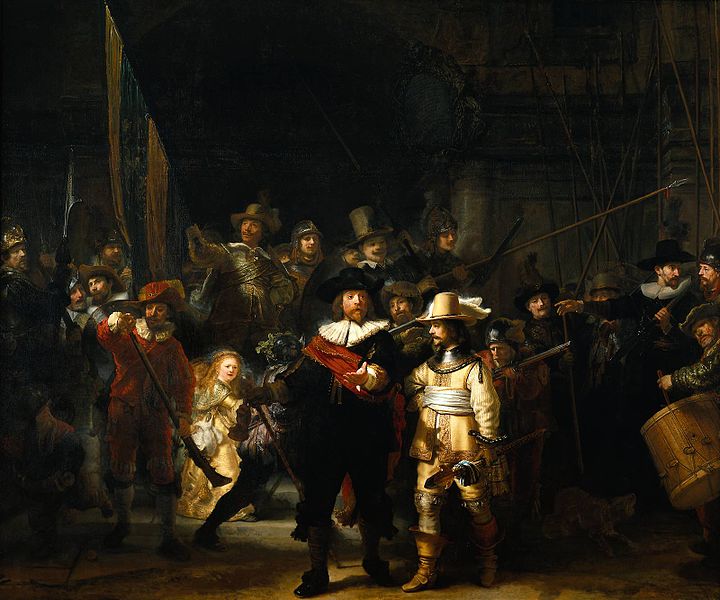
Let me illustrate with a bit of art history.

Rembrandt's 'THe Night Watch'

The image above is Rembrandt’s most famous work. It’s popularly called “The Night Watch” because its actual title is long and descriptive. Painted in 1642, The Night Watch is a scene of a militia gathered in the center of town surrounded by supporters. What few people know about The Night Watch is that it was covered with varnish sometime after Rembrandt’s death – as was the custom. Cleaned in 1940, the varnish came away and restorers discovered The Night Watch was actually a day scene! When they saw the lightened image (below) they realized that the popular title for the painting was all wrong.

The Nigh Watch (unvarnished)

Another little known fact – when The Night Watch was removed from its original location in the 1700s, the painting had to be trimmed to fit its new location. This process cut off two characters on the left side of the painting (seen below).

Night Watch trimmed

Now we know that for hundreds of years when people viewed The Night Watch, they did not see what the artist created. I believe that the same thing happens to our image of God. Our painful experiences are like dark varnish that shade and distort the way God meant for us to see him. 

How many of you have witnessed or experienced something so terrible that your concept of God no longer fits into your experience of the world? Maybe the recent school shooting in Connecticut or another world disaster or something closer to home has you wondering how God can really be good.

When something bad happens, how many of us trim God down so he can fit in our new understanding of reality? Unfortunately, when we do this, we cut off part of the story that God originally revealed to us. 

Rather than acknowledging and holding the tension between who God is and who the world portrays God to be, we allow life circumstances to distort the truth of God’s character.

Let me offer my life as an example. In the past six years I’ve experienced significant pain in circumstances both professional and personal. The past three years have been particularly difficult. What caused this pain is best kept in the confidence of my counselor and my mentors, so I’ll ask you to suspend your curiosity. Let me simply say that pain has varnished my life from sunshine to mud. Pain has distorted my image of God.The best way to illustrate this is to share a story from my days as a hospital chaplain. It’s a very difficult story to hear, but please bear with me.

One day I was working as the chaplain on call and was paged to the emergency department. There I met a young, single mother. Our staff was frantically trying to revive her four-year-old son.  During an hour of terrified waiting she told me what happened.

She and her son had been swimming in the family pool, he securely clipped in to a life jacket, she floating on a raft nearby. The grandfather came outside and the little boy said he wanted to go inside. They unhooked his life jacket and when he turned to go inside with grandpa, mom pushed off on her raft to continue relaxing. Several minutes later she decided to go check on her son and see if he had everything he needed. Only, she could not find him inside and grandpa hadn’t seen him. She raced outside and looked in the pool but didn’t see anything. (Later she told me the pool pump was broken and the water was very murky.) Thinking her son might have gone to the playground beyond their back gate, she raced there and ran around calling his name. She searched nearby and then ran back to their yard.  When she looked into the pool again, she saw a foot in the murky water of the deep end. She dove in, pulled out her son, yelled for the grandfather to call 9-1-1 and began CPR. None of the efforts of that mother or our staff saved that beautiful little boy. I lay on the floor with this devastated young mother as she wept that her child must never have gone inside, must have slipped back in the pool with her and drowned without her seeing or hearing him.

I worked many drownings when I was a chaplain. Unfortunately, few of them had happy endings. It sounds strange, but when tragedies like these are a part of your daily work, you learn methods to cope and move on to the next case. However, this drowning knocked me down. I could hardly function the next day, couldn’t bring myself to see patients, couldn’t stop the tears. I asked myself why this drowning was affecting me so personally and profoundly.

Through prayer and reflection I realized that I identified with that boy in the pool. The pool scene was my image of God. My circumstances made me feel like I was a child without a life-jacket, drowning in the murky waters of my life. Oh, I knew that God was with me like that mother was with her son in the pool, and I believed that God loved me as much as that weeping mother loved her child, but I felt like God had taken his eyes off of me and I was slipping under the water, unnoticed. Inside, my soul was crying out, “Don’t let me drown!”

Six years of painful experiences and events changed the way I saw and related to God. My image of God morphed from a loving parent to a neglectful parent who overlooked me. I had known what it was to bask in the love of my heavenly Father, but I could no longer feel the warmth of his gaze on my face.

Pain is not the end of my story. I’m walking a healing path. If you want a fuller picture of the healing in my relationship with God, listen to the sermon.  Here, I’ll simply list for you significant healing points. This is not my advice to you. It is not a step-by-step process or a self-help strategy. None of this was very intentional but was the result of a desperate desire to have my image of God and my relationship with God restored.

Lament – I embraced the biblical practice of lament and cried out to God. I took the Psalms and made their words my own when I had no words.

Prayer – I realized that my inner thoughts and prayers were sliding into a kind of un-holy and depressing complaint. I got sick of wallowing. I needed something constructive so I changed my prayer life. Prayer became an intentional time of silence where I simply acknowledged that I was in God’s presence. The only thing I ask of God is to be given consolation as I wait for things beyond my control to change.

Self-Exhortation – Sounds strange, but I reached a place where I had to confront myself. I had to ask myself the questions, “Corrie, is God negligent? Is that the truth of God’s character?” and then struggled toward the answer. It was a process of shoveling through the manure pile that was my pain and scraping through questions until I got to the bedrock of truth. I understood that I was the one who allowed my life circumstances to varnish and distort God’s image. Here is the most important question I unearthed: who is the artist of God’s image – me or God?  Put simply – who holds the paintbrush?

Sorting through Shadows and Light – Rembrandt was famous for a technique called chiaroscuro, using bold contrasts between darkness and light in a painting’s composition. Regrounding myself in the belief that God is the artist of his image and the Bible is his canvas, I’ve schooled myself to check the things the world says are true about God against what God has revealed as true. Having faith means that even when circumstances and feelings paint a bleak or dark picture in my understanding of God, I seek out the light. I find the light in the narratives of scripture.

I felt that God was a negligent parent who overlooked me in my pain, but as early as Genesis 16, the story of a downcast woman named Hagar reminds me that God is “the God who sees me.” So I focus on the light in this story, the truth of God’s character. The God I worship is one who sees the downcast, the abused, the runaways.  He is the God who finds them and who blesses them abundantly.

Waiting – I can’t tie this post up in a nice little bow for you. I have not reached ‘the other side’ of these tribulations, if there even is one. I realize that I am in control of very little that can change my circumstances, but I can shape my response to these things. I’m learning all kinds of difficult lessons about waiting, endurance and trust. I’m sure there are many blog posts to come about these.

I want to encourage you to think about ways in which painful life circumstances have varnished your image of God. Have you struggled for so long that you can no longer hold the tension between your life and your understanding of God?  Have you trimmed God down so he can fit into your understanding of the world?

If we believe scripture is the truth, then we need to see it as the canvas on which God painted his image for our viewing pleasure. If we want to be shaped by the Word and not the world, then we need to surrender the paintbrush. We need to give it back to the Master Artist. We need to gaze long and deep into God’s canvas, the Bible. We need to submit our feelings and our experiences to his story, to his revelation. Oh, what an image he creates!

If that message does not connect to your soul, then maybe it is time for you seek healing in your relationship with God. Maybe you need to look deep into your own story for the place where things went wrong and see how your image of God got stained and distorted.  Maybe it’s time to surrender the paintbrush and let the Master Artist restore his greatest work, the image of his love for you.

Return of the Prodigal Son, (detail) by Rembrandt Van Rijn

(The Return of the Prodigal Son (detail) by Rembrandt Van Rijn, 1669)

Death and Dawning – Holy Saturday

It’s late in the evening of Holy Saturday, 2012.  I’ve been a follower of Jesus for most of my life, so this day, though holy, is often just a blip between the utter desolation of Jesus’ death and ecstatic joy of his resurrection.  I surely miss out on this significant day because I know what’s coming.  I’ve already celebrated the end of the Easter story and danced in the redemption of the coming days.  But my dear friend and fellow blogger Stacey Gleddiesmith, as she reflects on the wisdom of Joan Chittister, reminds me that Holy Saturday is important because it is the day when all our dreams have died, but a day when we can grow in hope.  (Read her fabulous post at http://thinkingworship.com)  Challenged by Stacey and Joan, I let my imagination unfurl into a different time and place…

It’s year 33 and I am a young disciple of the newest Messiah figure, this one called Jesus, who is just a few years into what looks like a campaign for king.  I have been wandering around the hot desert for months with a carpenter-turned-rabbi who, though he speaks with an authority I had never heard in the synagogue, makes some wildly outrageous (and provocative) claims about the kingdom of God.  A kingdom he could almost literally conjure before my eyes through his riveting stories.  (It’s like he’s actually been to this wondrous places before.  I can almost smell the feast he describes floating on the back of the Galilean wind.)  Jesus’ teaching stirs parts of my soul that have laid as fallow as my father’s field during the sabbath year.  I left my family, my village, my security, to follow this man on a path toward an elusive hope, the hope that life might actually be more than the drudgery I’ve lived.  When I left, my friends called me a fool, my mother wept and my father roughly turned his back.

As I followed Jesus, I discovered a man with a passionate spirit who both perplexes and comforts me with his daily teaching on a kingdom that has no end.  A gentle radical who constructs images of a Godly kingdom (and I’ve lived the opposite) where children are praised for their faith and women are welcomed into the master’s circle.  A kingdom where I can lay down the burden of my shame (and believe me, my soul’s more spotted than the cheapest bird you could by in the Temple courts) and instead take up a yoke so different from this law that I can never fulfill.  Jesus tells me not to worry, because he has come to fulfill the law and the prophets, and when he says this, something in me…releases.  My new master tells me that I will know the truth and it will free me.  God, how I’ve hungered for truth, for freedom!

Throughout the months I was with him, Jesus talked a lot about his father, one so different from my own, a king who rushes to embrace the returning children who abandoned him to chase their own pleasures.  Jesus proclaimed himself the light of the world, the bread of life, the way, the truth, the resurrection and the life.  Even though I didn’t understand everything he said – his stories, his power to heal, his vision for a new kingdom of peace and love and justice, his shalom-filled welcome of the outcasts among us – these things slowly unwound the tight knots of pain and fear in my gut.

Something new was born in me as I followed my dusty rabbi.  It’s hard to describe, but deep in me, where I used to feel shame burning holes in my soul, there was a mending.  A burgeoning courage to live a new way.  And the closest I’ve ever come assurance.  By the end I was a believer in this new kingdom, a devotee of its good, loving king, and an avid disciple of Jesus, this prince among men.

But then Jesus was arrested.  Convicted.  Whipped.  Crucified.  Stripped.  Punctured.  Ridiculed.  Abandoned.

I did that.  Well, not all of it, just the last part.  I abandoned Jesus, but to me that single crime is just as bad as all the rest put together.  I didn’t stay to see the end, or even much of the middle.  (What I know about Jesus’ death, I learned from passersby.)  For all my new hope, the courage that was beginning to shine within me, the wisdom I’d learned at Jesus’ feet, I ran away shortly after I saw blood.  And now I lay here in the dirt, in the exact spot where I collapsed last night, exhausted after my flight from Golgotha.  I’m so endlessly tired from crying.  Wrecked from the confusion about what happened.  This crater of loss sucks me inside out.  What kind of disciple was I to run away when things got hot?

But what kind of rabbi – what kind of prince – what kind of Messiah dies like that?

I lay under a withered fig tree along the side of a road that leads nowhere.  This mouth that Jesus once filled with bread and fish and cool water is now gritty and putrified with dirt and shame.  Jesus made me feel such hope.  Following him made me feel so…vital, like I was living for the first time.  Now I lay here an empty shell.  This is worse than all those years of drudgery back home.  This is nothingness.

I laid in the dirt for hours.  Silent.  Sullen.  Hollow.  Despondent.  Fearful.  It was so dark but I didn’t care if the sun never rose again.  But then somewhere, deep in that pit that held me captive, I heard a whisper.

“I am the light of the world.”

“I am the resurrection and the life.”

“Whoever lives and believes in me will never die.”

Between each whisper I feel the thump of my heart, tacky and faint, but there.  I’m still alive.  I want to live, I realize.  I want to live the life that Jesus sketched in the sand of my country.  He said he was the resurrection.  I never understood that.  But, what if?  Slowly, I push myself up on my elbows.  With my hands gripping clumps of dirt, I look toward the horizon.  I wait, wondering.

Where is the light of the world?

Where is the resurrection and the life?

As light slowly hems the eastern hills, a morsel of warmth dawns within me and begins to spread.  Curious, I push to my feet.  The sun is rising and I have this uncanny feeling that today will bring…I don’t know quite what.  But something, something more than this roadside grave I’ve made for myself.  Hoping he is who he said he is, I turn back to Jerusalem, and begin to run.

The Sixth Lent: Musical Abstinence

I’m still a novice at Lent; this is just my 6th season out of 32 years of life.   My first year I gave up sarcasm and exaggeration and learned an important (and humorous) lesson in growing into, rather than jumping into, a new spiritual practice.  Last year, when I prepared for my forty day fast, I dabbled with the idea of giving up music.  I first thought to give it up entirely, but then my body started twitching and my eyes began to sting and, in a gasping moment of reality when my tongue when numb, I realized that giving up music cold turkey might be a bit extreme.

Abstaining from music for four weeks would be a radically ascetic experiment for this melomane.  (That’s French for “music lover” and said with the caressing accent it gives you a sense of my love affair with music.)  Living without music for 960 hours, or 57,600 minutes, or 345,6000 seconds?  That’s like the 4th of July without the block parties, fruit-flag desserts, crepe-papered bicycles and chest-thumping fireworks.  Last year I wimped out and gave up added sugars, which was challenging, but nothing close to giving up my precious music.

2011 was a difficult year because of a sense of vocational stuntedness and a family loss.  2012 hasn’t yet loosened the grip its neighbor held on my heart.  For me, listening to music and singing along is often as cathartic as sipping a cool cup of water in the scorching Phoenix heat or shattering a glass against the hard stones of a fireplace.  But sometimes I abuse music.  I abuse it, and myself, when I use music to tune out the voice of my inner life.  I suspect that in the past year, music has been more of a muffle than a balm.  So, as much as I love music, as much as it gives me joy and energy and a certain dancing-in-my-soul verve, I decided to set it aside for a time.

I don’t want to become a person who claims that God has abandoned me in hard times.  Maybe I’m not hearing God’s voice because it’s hard to hear a whisper through a cotton ball.  Maybe God is offering me sweet melodies of truth and consolation that would bind together the ragged linings of my soul but I’m not listening well.  Maybe I’ve turned music into noise, a distraction, just an excuse not to courageously face the somewhat barren landscape of my life and follow my Savior Jesus as he ventured, alone, without supplies, into the desert.  Maybe the key to hearing God in the desert is clearing away all the distraction and stepping into aloneness with God.

Conviction tells me it’s time to clean out my ears, so I’ve instituted a silent commute for Lent.  For the two, thirty minute trips to and from work each day, there’s no top 40, no cds, no talk radio.  There’s just the sound of my breathing, the rev of my car’s engine, the squeak of breaks and the hum of tires rubbing against the pavement.  Yesterday at an intersection, the service truck next to me was blaring “Low Rider” and before I knew it I was bobbing my head in time and smiling at the driver.  I miss the music that got me merrily home but in the silence I’ve discovered a jam of thoughts and prayers waiting for their right of way.  In just two weeks, I’ve run into a lot of unanswered questions, discovered wounds that need healing, and prayed that God would grant me the senses to see, hear and feel hope for my future.  I’ve realized how self-centered I am and found forgiveness.  And it seems that with each turn of my tires I chant the name Sara – the one who left our family for other happiness.  But mostly, I sit in silence and listen to the sounds of my commute, the beeps, rubbing, the rattles, which remind me that though I am sitting still, I am going somewhere.

This morning in the silence an old chorus popped into my head – “Thou O Lord, art a shield about me; you’re my glory; you’re the lifter of my head.”  I believe those words are true, but I’m not able to feel their truth now.  As I hummed the chorus throughout the day, I stumbled across a thought – maybe it’s not my song to sing; it’s God’s song for me.   I the Lord, art a shield about you, I’m your glory, I’m the lifter of your head.  Okay Lord, I’m listening.  Thanks to the silence.


I Thirst

The following is a homily I delivered tonight as part of a Good Friday tenebrae service. 

“Later, knowing that all was now completed, and so that Scripture would be fulfilled, Jesus said, ‘I thirst.'”  (John 19:28)

It was early summer in 1999 when I spent a month studying and traveling through Israel.  I was taking a course on the religions, history and archeology of the Holy Land and spent hours each day hiking through ancient ruins.  Having grown up in Ohio and lived in costal California, I wasn’t used to the intense heat and wilting sunshine of the desert.  I remember one day where temperatures soared over 120 degrees and no matter how much water I drank, I remained incredibly thirsty.

When I chose these words of Jesus for my homily, my first instinct was to attribute his thirst to Israel’s oppressive heat.  But then last week I spent an afternoon slowly reading the Gospel of John aloud, doing my best to pause and place myself in each scene as an eyewitness to Jesus’ ministry.  That exercise led me to a very different conclusion about Jesus’s statement, “I thirst.”

Just a few moments into John’s story, I found myself a guest at a wedding feast where Jesus, informed that the wine was running low, turned six vats of water into the finest quality wine.  His very first miracle was to quench people’s thirst!

Missing Jesus’ involvement and the miraculous transformation, the master of the banquet says to the bridegroom, “Everyone brings out the choice wine first and then the cheaper wine after the guests have had too much to drink; but you have saved the best till now.”  I don’t think the master of the banquet realized he was speaking symbolically about Jesus.

A few months later I watch as Jesus, weary from a long journey by foot, stops to rest outside Samaria, a city of people scorned by Jews.  There’s a woman sitting alone at the well.  She’s an outcast among outcasts; she’s had a suspicious number of husbands and now lives with a man who is not her husband.  From this unclean woman Jesus asks for a drink.  They have a provocative conversation, during which Jesus tells the woman that he can offer her “living” water that will “spring up into eternal life.”  He claims that if she drinks his living water she will never thirst again.  It’s obvious he’s not talking about physical thirst or literal water.

Flash forward to the Feast of Tabernacles when Jesus tells the crowds gathered in Jerusalem’s temple courts, “Let anyone who is thirsty come to me and drink.  Whoever believes in me, rivers of living water will flow from within them.”

Eventually I reach this point in the story – the crucifixion.  By now, Jesus has been betrayed, arrested, questioned, falsely accused and handed over to Pilate.  He’s been slapped in the face, whipped, mocked and ridiculed.  Finally, he is stripped naked and nailed to a cross.

He’s been hanging there for hours.  He’s exposed and exhausted and I’m not surprised when Jesus says he is thirsty.  His thirst is certainly a result of his weakened state, the abuse he’s suffered and exposure to the heat and sun.  But now, when I hear the words, “I thirst,” I think back over the three years of Jesus’ ministry.  I remember the wedding feast when Jesus turned water into wine.  I think of when he offered the lowliest of people living water, eternal life.  And I remember his words from the day he preached on a mountainside, “Blessed are those who hunger and thirst for righteousness, for they will be filled.”

Jesus says he is thirsty and I watch as a nearby solider soaks a sponge in wine and lifts it up for Jesus to drink.  Except, this is not fine wine fit for a king.  It’s the vinegar extracts of a cheap wine too bitter to drink.

The contrasts are clear between what Jesus offered and what he received:

Jesus gathered disciples, loved them and taught them the way of truth; they betrayed, denied and deserted him.

Jesus treated people like honored guests at his Father’s banquet; they rejected and crucified him as a criminal.

Jesus gave the people the finest wine to drink; they gave him bitter vinegar.

Jesus offered to forever quench the spiritual thirst of undeserving sinners; they nailed him to two slabs of wood and left him to die, thirsty.

Physically thirsty – yes – but more than that.  I think that Jesus, in his very last moments, is still desperately thirsty for the spiritually parched people witnessing his death, to believe that he is the Son of God able to give them the living water of eternal life.