The Parable of the Betta Fish and the Samaritan Woman

I pulled into a local Starbucks, bought a latte and joined my friend Jessica at an outdoor table. After I sat she casually asked, “So how are you?” Her tone did not carry any sympathy — she clearly didn’t know that I got laid off earlier in the week, so I filled her in. Jessica knows my story; she’s witnessed my struggle to find full-time ministry employment over the last three years. She is also a member of the church where I serve as a part-time pastor. She listened attentively to this latest development. Her face showed clear understanding and compassion. When I stopped speaking she said, “So, we have this betta fish named Rosie…”

Rosie

I’m not kidding. That was her response to my news. I blinked a couple of times and waited, wondering how a fish was somehow relevant to my current setback. She went on without preamble.

“We all love Rosie. I know it sounds silly; she’s just a fish, but she feels like part of our family.” (Jessica is married to Dan and they have two adorable little girls.) “Last week I was cleaning out Rosie’s bowl and when I went to put her back in, I accidentally dropped Rosie on the kitchen counter. There she was flopping around on our counter and I was doing my best to get her in my hand but she was too slippery. So I picked up the bowl, put its lid along the top of the counter and tried to push Rosie in, but then she fell all the way to the ground! She flopped around weakly and I thought she only had moments to live. By then I’m yelling for Dan to come help me and my girls are standing close by yelling, “Save Rosie!” “Oh, no!” “Don’t let her die!” I’m so distressed that I’m making all kinds of strange noises and Dan comes running into the room to help rescue Rosie. He calmly gets her back into the bowl and she starts to swim around but I can tell she’s just not right.

I try to prepare the girls — I want to be realistic; she’s just a fish — so I tell them that even though Rosie is fine right now, she could be dead by morning. So we get up the next morning and Rosie is still alive. I caution the girls that she could still die. Every day this week I have come home expecting to find Rosie floating at the top of her bowl, but she’s still swimming.”

And then Jessica’s strange and humorous story became a parable that tolled something in my spirit. She suddenly said, “Corrie you are like Rosie; you’re resilient.”

Jessica spoke with assurance and a smile. I was not so confident. Am I resilient? The fact is that I have gained and lost several jobs and many more opportunities over the last three years. Extended periods of unemployment combined with the regular rejection that comes with pursuing a significant dream have been like an erosion of my soul, motivation and self-confidence. I feel like these storms have stripped me of my heartiness and joviality and I’ve been left dizzy and breathless from the whirlwind of my life.

And then there is the physical buffeting! I’ve gained and lost the same 20 pounds three times. I’ve struggled with anxiety and sleepless nights. I have a new crop of silver hairs haphazardly spiking out of my dark brown waves. When I look in the mirror I see the effects that the disappointments, rejections and set backs have had on me — the story is in the slump of my posture, the slight sagging around my eyes, the delay in my smile. I’m battle worn in ways I never anticipated I would be at this age.

No, I think when I see myself in the mirror, I’m not particularly resilient.

For me the word conjures up images of Arthur and Excalibur, of the Great Wall of China, even the Brooklyn Bridge. I think in comparison that I’m not so strong, so enduring. But Rosie’s story and Jessica’s smile stuck with me. A few days later I looked it up in the dictionary.

Re-sil-ient: adjective

: able to become strong, healthy, or successful again after something bad happens

: able to return to an original shape after being pulled, stretched, pressed, bent, etc.

Two weeks have passed since I had coffee with Jessica. Three weeks since I lost my job and Rosie flopped around on the kitchen floor. These three weeks have been something of an awakening. Friends have called wanting to check in on me and offer support, knowing from past experience that I might need some extra shoring up. I don’t know who has been more surprised, them or me, to find me coping so well.

With lots of time for introspection, I’ve realized that though buffeted and tossed around, I haven’t been broken beyond repair. As the emotional effects of this recent loss lessen, under my weariness and discouragement I sense a stronger core. I’ve been through great storms of rejection, loss and despair and survived every one. (There’s got to be something of the miraculous in that.) I’m not the same as I once was. I’ve lost my idealism and naiveté about the course of my life, which I understand as a good and necessary thing, but I’m still a positive person. I’ve walked (and sometimes crawled) across the desert of spiritual crisis that comes with the difficulty of following any big dream. Along the way I’ve thought about giving up (many times), I’ve doubted myself and I’ve had some major pity parties. From that self-perpetuating mess I’ve learned to seek the things that lead to life instead of death.

Even the unintelligent betta fish knows to flop about when it finds itself out-of-water. All that flopping is an instinctual effort to somehow find water. Whether it is a puddle, a bowl or a lake — for the fish, where there is water there is life. Picturing Rosie’s struggle on the cold, dry tiles of the kitchen floor, I realize that I’ve taken on her instinct for life. After three years of flopping about, I now spend less time doubting and pitying and more time focusing on positive, true and enduring things. I’m not denying my struggle, but I’m also not giving it more than its due time and attention. I’m trying my best to seek my water source.

Two months ago I attended a large women’s conference. Kanyere Eaton, the pastor leading one of the workshops, had us read a page of self-affirmation. I recently pulled it out again. Here are some of the gems:

I am the beloved of the Lord…Before I cried for the first time, he was intimately acquainted with the sound of my voice…God specifically picked out the spiritual gifts that he invested in me and he wants me to use them for his glory. God has plans for me. The vineyard of my life is his planting. The fruit he calls me to produce has a unique capacity to nourish and enrich the lives of those who partake of it. The vineyard God has given me is mine to tend. It will grow and develop sweet fruit when I make time to nourish it. I confess that I have not always considered my vineyard significant…I am very important to God…My spiritual, emotional and physical needs are important and they deserve to be tenderly addressed. My Holy Spirit-inspired dreams are precious and they deserve serious investment. The Holy Spirit calls me, even in this season of my life, to carefully, consciously tend the vineyard of my own life. By God’s grace, I begin today.

I confess that I have not always considered my vineyard very significant, but I now I can honestly mark my report card “shows improvement.” Like Rosie, I’m making every effort to flop toward water.

Years ago I regularly practiced examen, a spiritual discipline of daily identifying my most life-giving and life-taking moments. Over the course of time you can line up your records and begin to see patterns, to see clearly the things that lead to life or death. Two weeks ago I bought a new journal just to record my examen findings, an effort to stay near my water source.

journal

Last week I flew to Denver to spend time with my brother and nephews. My 10-year-old nephew told me that his dream is to get a college scholarship for soccer, then to be a scientist and a professional lacrosse player. His silly aunt tried to gently convince him that he probably wouldn’t be able to make a living as a professional lacrosse player; he was adamant that he would. The important thing about that conversation was the beauty on Mason’s face when he shared his dreams with me. He had such hope for the future. Staring at that beauty, I suddenly realized how long it has been since I dreamed new dreams for myself.

The next day I walked into an artisan gift shop and found these round tins with beautifully engraved wood tops. The instructions say to write down my fondest dream, greatest desire, or strongest wish on a small piece of paper, put the paper in the ‘Dreambox’ and place it beside my bed. I’m supposed to hold the box every night and every morning and think on my dream, “believing with all my heart that it is so.” I’m not superstitious and I don’t believe in magic, but I do believe in hope and I know I could use some more hope in my life. I bought a Dreambox with the lid design that looks like a rose window. I’m choosing to believe what Pastor Eaton taught me, that my Holy Spirit-inspired dreams are precious and they deserve serious investment, even in this season of my life.

The Rose Window at All Souls Church, Bangor

In hindsight I can see my resilience, my strengthened core. Able to is the key phrase in the definition of resilience; that’s why Jessica was right in comparing me to her betta fish. Really, I’m just a person with a penchant to throw more tantrums than I do celebrations. God, as my water source, enables me to be strong, healthy or successful again after something bad happens. God is the author of resilience, the one who makes all things new. This reminds me of Jesus’ conversation with the Samaritan women:

Jesus replied, “If you only knew the gift God has for you and who you are speaking to, you would ask me, and I would give you living water.”

“But sir, you don’t have a rope or a bucket,” she said, “and this well is very deep. Where would you get this living water? And besides, do you think you’re greater than our ancestor Jacob, who gave us this well? How can you offer better water than he and his sons and his animals enjoyed?”

Jesus replied, “Anyone who drinks this water will soon become thirsty again. But those who drink the water I give will never be thirsty again. It becomes a fresh, bubbling spring within them, giving them eternal life.”

“Please, sir,” the woman said, “give me this water! Then I’ll never be thirsty again, and I won’t have to come here to get water.”         (John 4:10-15, NLT)

I’ve learned that much of coping and dealing with life is a choice. I’m in control of very little in my life and circumstances. I certainly didn’t want to be unemployed again, but here I am. I’m faced with choices. Do I let myself sink back into the bad habits of wallowing and tantrums or do I reach out weak hands toward my water source?

Resilience is to be like the Samaritan woman, acknowledging my need for water I cannot supply for myself. It is turning again and again to Jesus when I face hardship and asking, “Please sir, give me this water!”

Resilience is to mimic the floppings of a betta fish, whose only instinct is to seek water, the source of its very breath.

“…For he satisfies the thirsty and fills the hungry with good things.” (Psalm 107:9)

Amen and Amen.

Mercy Misunderstood

Parole board rejects clemency for killer
Columbus, Ohio — A condemned Cleveland killer moved one step closer to execution Tuesday despite a rare plea for mercy from the prosecutor overseeing his case and support from nearly half of a board that previously voted unanimously against him. The Ohio Parole Board voted 6-4 to turn down a request for clemency for death row inmate Billy Slagle, sentenced to die for stabbing a neighbor 17 times almost three decades ago.  (The Arizona Republic, Wed. July 17, 2013, pg. A2, emphasis mine)

Mercy is a short word, widely misunderstood and sometimes wildly misused. Exodus 34:6-7 says, “The Lord, the Lord, a God merciful and gracious, slow to anger, and abounding in steadfast love and faithfulness, keeping steadfast love for the thousandth generation, forgiving iniquity and transgression and sin…” Mercy is one of the fundamental expressions of God’s character. As such, it is critical that we know what mercy is and what it is not.

The clip from The Arizona Republic is just one of many recent media examples of how we in the 21st century mistake clemency for mercy. Clemency is a power of certain public officials, like the governor, president or a judge, to lessen the punishment of a prisoner. On July 9th of this year a Florida man named Marshall Gore was 25 hours from death by lethal injection when a judge stopped his execution. Though a jury had found Gore guilty of murder, the judge felt his sentence did not take into account certain facts, so Gore remains alive. That’s clemency and it’s a pretty big deal, but it is NOT the same as the mercy we have received from God.

Imagine yourself a criminal. You are tried and found guilty of breaking the ultimate law, God’s law. Your sentence is death and now you live on death row waiting for your execution. Mercy is not just God lessening your penalty from death to life in prison. Mercy is God sending his only son to die the criminal’s death in your place. Mercy is God smashing the chains that bind your hands and feet, shattering your cell door from it’s hinges and crumbling the prison to ash. Mercy is God setting you free forever and then welcoming you to live eternally in his kingdom.

God is merciful, gracious and abounding in love, so never mistake mercy for clemency. Mercy is so much more!

But you are a chosen people, a royal priesthood, a holy nation, God’s special possession, that you may declare the praises of him who called you out of darkness into his wonderful light. Once you were not a people, but now you are the people of God; once you had not received mercy, but now you have received mercy. 1 Peter 2:9-10

Don’t Just Pray – Part 2

“Just pray about it.”

We’ve all probably been on the giving or receiving end of this bit of advice. Usually we hear it after we pour out a steaming hot mess of things like doubt, fear, confusion or anger. We take the risk of being vulnerable with a trusted friend or mentor, we expose the mess of our lives to someone we hope will listen, who may have some new, wise guidance, and then their response is, “just pray about it.”

On the one hand, this is fantastic advice. The evidence of the power of prayer in the Bible is as bright as thousands of bulbs that light the Rockefeller Square Christmas tree each year. Open, honest and bold communication of the faithful to their heavenly Father often leads to divine intervention. Do you recall the story of a woman named Hannah in the Old Testament? Her anguished prayers caused God to act.

Samuel 1:13 says, “Hannah was praying in her heart, and her lips were moving but her voice was not heard.” Her prayers were so fervent that when the priest Eli saw her, he assumed she was drunk and rebuked her. Hannah faces Eli and corrects him saying,

“I am a woman who is deeply troubled. I have not been drinking wine or beer; I was pouring out my soul to the Lord. Do not take your servant for a wicked woman; I have been praying here out of my great anguish and grief.” (vv. 15-16, NIV)

So corrected, Eli speaks this blessing over her, “Go in peace, and may the God of Israel grant you what you have asked of him.” Hannah prayed and God “remembered” her (v. 19) by opening the womb he had previously closed (v. 5).

Because of prayer a barren woman conceived and birthed a son.

This is not an isolated incident. In the Bible, prayer regularly prompts change; it brings resolve, stops plagues and leads to miraculous acts of remembrance. Prayer, literally and metaphorically, leads to life.

Prayer is a direct line of communication with the Creator and Sustainer who out of compassion and love, continuously pours out blessing on his people. As such, prayer is something we should do regularly, eagerly, expectantly and most of all, reverently. But too often we approach prayer the same way we do an ATM.

When I need cash, I go to the ATM, insert my card, make a few simple demands at the push of a button and, voilà – out pops my money! We all know better than to liken God to an ATM, so why do so many of us use prayer like a debit card? Don’t we often speak words of prayer hoping we ‘push the right buttons’ and then wait to receive the ‘cash’ to which we are entitled?

Don’t misunderstand me – there’s nothing wrong with expecting great things from prayer! But spiritual things are seldom as simple as taking money from an ATM.

What I didn’t mention earlier about Hannah is that she prayed for a child for years. Hannah was overcome with grief. Like many grieving people, she lost her appetite and probably that healthy glow people call a luster. Hannah wept and she prayed. She prayed and she wept. The Bible says this went on “year after year” (v. 5). While Hannah grieved, her husband’s other wife  (who had many healthy children) taunted Hannah cruelly for her barrenness.

Prayer is powerful. It prompts God to compassionate and merciful action on behalf of his people, but in Hannah’s story we learn that the effects of prayer are not always prompt. That is why it can be so disheartening and insensitive to tell an aching soul, “Just pray about it.” If this is all we say before we walk away from a friend, he or she may feel that we’ve minimized their grief or been deaf and blind to their desperation.

For those who haven’t been utterly ravaged by time and circumstance, for those who still have enough hope to cling to the promises of prayer, the expectation of prompt results carried by the phrase “just pray about it” may be the nick that severs their connection to hope or even to God.

If you have a desperate need or desire and have been waiting and praying for days or months for fulfillment, how strong is your hope? Can it bear the weight of silence or the terrible agitation that grows as time beats through your veins and nothing happens?

What if your season of need stretches into months like Hannah’s? What will your faith be like then? What will you need from your friends? Just prayer, or prayer and…something?

Prayer is an awesome thing but when we are caring for aching people, there are things that complement prayer and bring consolation. Don’t just pray and walk away; your friend does not have that luxury – they are in a sense held captive (think slavery) by their need. They cannot conceptualize life or their future without that thing for which you may casually pray. Instead of just praying, consider these:

  1. Pray and pour out your soul – Too often prayer is an exercise of suppression rather than passion. There’s no need to hide or hold back our feelings from God because he sees everything in our souls. The good news is that it’s safe to confess it all to him. Let yourself be emotional as you pray. Hannah let even the nasty stuff like bitterness and anguish pour out of her soul. It’s only when we pour out the nasty stuff that we make room for God to fill our souls with consolation.
  2. Pray and listen – Don’t think prayer ends when you stop speaking. Make time and space to listen into the silence and stillness for the voice of God. Don’t rush off; stay rooted in your seats, be still and know that God is in this with you.
  3. Pray and wait and pray again – Hannah prayed the same prayer for years. Years! She’s one to emulate. If someone shares with you their requests, keep praying. Go back to them next week, next month or next year and get an update. Pray again. Listen with them. Wait with them. Pray again. In this way you bear one another’s burdens.
  4. Pray and lament – Lament is not just emotional prayer. To lament is to cry out to God against the things that should not be – against injustice, cruelty and abandonment, hunger and despair – against anything that falls short of God’s character and provision. The Israelites lamented throughout their history and God remembered them, which means he acted for them.

Out of respect to people like Hannah, I must acknowledge a very difficult truth before I close: prayer will not always lead to the things we so desperately seek or expect. God may not give us what we want, even if we are faithful and in a sense ‘deserving.’ And there will be times when it seems that God gives no response to our prayers. (This is one of the mysterious things about God that makes everything in me go quiet.)

But these things do not mean that our prayers are empty or pointless, nor are they signs that God does not love or bless us.

I have many friends who are haunted by infertility. Unlike Hannah, some of these faithful women will never conceive or welcome a healthy child into the world. I hate that this is their reality. I don’t know what their desire or loss feels like but I certainly do pray with and for them. But I don’t just pray.

I pour out my soul with them. I listen into the silence with them. I lament their empty wombs and their grief. I wait for God to move. I expect God to move. I call upon God to do something that matches his wonderful character. I pray and wait and pray hoping that somehow, and in some way, God will make all things new.

Don’t Just Pray – Part 1

I often cringe at the strange things we Christians say and do in the name of Jesus. You’ve probably seen a bumper sticker that says, “Honk if you love Jesus.” That’s the kind of thing that makes me roll my eyes. Last week on my commute I passed a car with this message stuck to the bumper, “Any fool can honk. If you love Jesus, do justice.” This second sticker made me so happy I almost honked!

There’s something new that has been bothering me lately. Everywhere I go these days I hear believers praying the word just. With this word I’d expect insignificant requests. The word just makes me think of a young child whining to his parents, “It’s just an ice cream cone” or, “I just want my toy back.”

But it seems that everywhere I go I hear Christians praying like this —

“God, would you just fill us with your Spirit so we can…”

“God, will you just heal my mother’s cancer…”

“God, I just ask that you would fix this marriage…”

“God, I just need you lead me toward the right job…”

Only worshippers of a powerful, attentive and personal God pray for big things like God’s presence, miraculous healing, and rescue from untenable circumstances. So why do so many of us litter our prayers with a word that, in this context, means only, merely or simply? Why are we praying for mighty acts using limp language?

Now, if we were to say – “Lord, be just and topple the drug lords” or “God, pour out just acts for those who cannot protect themselves,” – I’d not protest. Unfortunately, our just prayers minimize and contradict the content of our requests.

Imagine being granted a private audience with the President to request funds that would alleviate a major problem in our city. Knowing this is a significant opportunity, you prepare your pitch carefully. Would you go before the President and say, “Sir, we don’t need much to fix our city, just one hundred million dollars”? I imagine not.

So why do we go before the God who has promised to provide for us in our need, the Almighty God, and ask him to just do this or that?

Why do we go before God with our hands stretched out to receive but our language tentative?

Ephesians 3:10-12 says, “His intent was that now, through the church, the manifold wisdom of God should be made known to the rulers and authorities in the heavenly realms, according to his eternal purpose that he accomplished in Christ Jesus our Lord. In him and through faith in him we may approach God with freedom and confidence. (NIV, emphasis mine)

What we’ve translated as freedom is a Greek word that is a freedom of speech. It means to speak openly and frankly, without ambiguity. It can also be well translated as “boldness” or “assurance.”

Jesus said to his disciples, “I no longer call you servants, because a servant does not know his master’s business. Instead, I have called you friends, for everything that I learned from my Father I have made known to you.” (John 15:15, emphasis mine) When he ascended to heaven Jesus left his friends in charge of spreading the good news he had shown them. He gave them the gift of the Holy Spirit to guide, convict and inspire them along the way. These friends had no need for a Moses to speak for them or a high priest to be their intermediary. These friends were the beloved children of God with direct access to their Father.

We are they who are charged to take the gospel to the world.

We are they who have direct access to the God who can heal every disease with a word.

We are the heirs of the God of creation and redemption, the God of miracles.

Our prayer should flow out of our identity. There is no need for us to just ask for anything. Friends of Jesus should pray boldly, not weakly. Beloved children of God should pray intimately, with assurance, not with lazy language.

If you are a friend of Jesus, a child of God, then don’t just pray.

Doctor of Goodwill

Woman: (laying in bed, looking at a man passing the doorway to her room) Who was that?
Chaplain: That is your doctor. He’s going to come visit you to see how you are doing.
Woman: Oh, another doctor!
Chaplain: You haven’t seen a doctor already this morning, have you?
Woman: I mean you, dear.
Chaplain: (chuckling with a smile) I’m not a doctor.
Woman: Yes, you are!
Chaplain: (Thinking she’s getting confused. She has Alzheimer’s.) Oh, really? Well, what kind of doctor am I?
Woman: (grasping my hand and smiling) You are the doctor of goodwill.

_________

People assume that being a hospice chaplain would be depressing; they are wrong. Everyday my patients inspire and encourage me.

Death is sad because it always involves loss, but death also has the potential to spark something good within us. The expertise of the dying is passing on life to another human being — this I am learning.

I receive and hold their spirit as a precious gift.

Seeking the Shepherd’s Heart: A Call for Empathy to Men in Ministry

woman_at_the_well2

Not long ago my father talked to a prominent pastor who also leads a seminary. The seminary’s branding is all about having a shepherd’s heart, encouraging students to emulate the Good Shepherd, Jesus. Somehow my father and this pastor came to the topic of women in ministry and the theology that separates egalitarians and complementarians. Dad shared some of the struggles I’ve encountered being a woman in ministry. The pastor responded with, “I don’t mind when people have [egalitarian] views, I just don’t like it when they get angry about it.”

When my father relayed the conversation, I asked him to repeat it several times. A few days later, I questioned him for exact wording. I didn’t want to make assumptions or emotional responses based upon them. When it was clear that this was the pastor’s actual statement, I let myself feel fully the disappointment and frustration that I had been holding back.

One of the most difficult things about being a female pastor is the lack of compassion I see among Christian men, especially pastors. I’ve lost count of the times I’ve heard men give these responses to the topic of women in ministry:

“This isn’t my issue.”

“This isn’t a primary theological issue.”

“This isn’t a salvation issue.”

“I don’t know why they get emotional about it.”

“I just don’t like it when they get angry about it.”

These sentences are usually followed by one of two responses. The speakers either shrug, frown slightly and politely turn the conversation to a different subject or they begin quoting isolated verses from scripture and very pointedly ask, “Well, what do you do with this verse?” The tone that is used unmistakably implies that a female pastor’s vocation can be nullified by theology that hinges on a single sentence from 1 Corinthians or Timothy.

This post is not a theological foundation for women in ministry. Instead, this is a plea to influential men in the church, to elders and leaders and pastors who believe women are NOT called to ministry in the same way as men. Will you please take three minutes to read this post in its entirety?

My plea begins with a question. As shepherds of God’s flock — as called, gifted and appointed leaders of the church — do you believe that empathy should be a part of your leadership?

We all probably know or have served under excellent leaders. In my opinion, the best leaders are those who are quick to listen and slow to offer their own opinion. Excellent leaders never use their opinion or beliefs as a weapon against another person.

The pastors I admire the most are those who solicit the stories and experiences of people different from themselves. They earn my respect because their actions reflect that of the Good Shepherd. Jesus was a leader who ushered angry, frustrated, misunderstood and hurting people — even his enemies — not onto the stage for a debate or between the ropes of a boxing ring but to a table where they could share a meal. Sitting face to face, breaking bread and sharing wine and stories, Jesus had ample space and time to listen well. Across a table he could watch their faces, the theater of human emotions. The ministry of Jesus was fearless engagement, patient listening and compassionate conversation.

Return with me to the topic of women in ministry and consider a few more questions. To disregard, to show apathy, to minimize or to go on the verbal offensive when one (or many) of your flock holds a different theological viewpoint from your own — are these the actions of a good shepherd? Is this showing empathy like Jesus? Unfortunately, what I have encountered, first as a faithful church-goer and later as a woman in ministry, very often falls far short of Jesus’ example.

From childhood until age 26, every pastor I encountered was male. I grew up in a wide-spread evangelical denomination whose global missionary work is noted in church history books. I went to a non-denominational Christian college and a trans-denominational Christian graduate school, both evangelical and highly respected by people across the theological spectrum. I earned a B.A. in Biblical Studies and a Master of Divinity. In these programs men were the majority among both students and professors. I now serve in a denomination that has been ordaining women since the 1970s but the local churches rarely hire pastors from the large pool of licensed and ordained female candidates. All that to say, I know what I’m talking about. I have a testimony about women in ministry and my testimony is true. My story and experiences parallel those of so many evangelical women in ministry, so I invite you to read the following as a trustworthy generalization.

Since childhood, I have seen and heard of the great work God is doing through female missionaries the world over. They are giving voice to the oppressed, rescuing women and children from sexual slavery, planting and strengthening churches and preaching the gospel. But when these women come home on furlough, many of them are not called pastor by the churches that support them financially. They can “share their testimony” on Sunday morning but they are not permitted to “preach.” They may lead a church in Africa or Asia or South America where the gospel is spreading like only good news can, but many denominations would never allow them to do so in the United States.

During seminary I interned at a small church. The leadership of this church gave me complete freedom to develop and lead a ministry to our young adults, a demographic which made up 70% of our congregation. During my second year, I was joined by another female and two males interns. On our orientation day, the pastor announced secondary responsibilities for each of us. The male interns were expected to preach once a semester. We females were expected to oversee the hospitality ministry, which meant preparing coffee and cinnamon buns, passing out welcome bags on Sundays, and organizing monthly potlucks. I assure you that these responsibilities had nothing to do with the spiritual gifts of the four individuals.

“Women in ministry” is a hot topic in colleges, seminaries and churches around the country, in many denominations. We’ve labeled this a controversy, a debate or an issue but it is much more significant than these labels. It’s more significant because it concerns flesh and blood people, women who, like you, are created in the image of God. These women make up half the church.

I imagine that you believe that women have vital spiritual gifts, given by God. You probably even believe that women are your co-heralds and co-agents of God’s mercy, love, justice and peace on earth. Have you ever considered what would happen if you told all the women in your congregation that because of their gender, they cannot use their gifts (no matter the gift) in or for the church? What would happen to the spirit of your congregation? The vibrancy of your mission? Your ability to impact your community? Your numbers?

Have you ever had someone walk up to you and tell you are sinning because you, a man, have preached from the Word of God?

Have you ever considered what it would feel like to have people in a church whisper about you and the scandal you have created by asking to preach the good news to a congregation you know and love and have faithfully served? Have you ever been made to feel like a Jezebel when you asked to share the message of hope to the depressed, to pass real peace to the world-weary, and speak truth to the thirsty? I have.

Men, you are absolutely right when you say that women in ministry is not your issue. It is our issue. It is not exclusively a male issue or a female issue, it is a church issue. This is an important topic for all people of God because once we were all sinners. At the same moment and by the same blood men and women were cleansed and wholly forgiven of their sin. We were adopted by God and now we are a family. We are one body, the body of Christ, and as members of this body we are all fully redeemed and equally essential to carry out God’s mission on earth.

Brothers in ministry, when you fail to engage in this conversation or you only want to debate egalitarians into a rhetorical corner, you make us feel like opponents or enemies rather than siblings, friends or even welcomed strangers. Facing either dismissiveness or aggressiveness, why should people be surprised when we get defensive or emotional in response?

When men say they don’t understand why we get emotional about this “issue” or don’t like it when we get angry, they shame us for our emotions. (This may not be the intention, but it is the effect.) But aren’t we all — women and men — emotional beings, created as such by God?

A wise man taught me that emotions are the windows of the soul. As a counselor I’ve learned that heightened emotions like anger and tears are flags that mark deeper fields to be mined. That is why I was discouraged and frustrated by the response of the prominent pastor from my initial story. Here again is another man who, though he is called pastor and respected as the shepherd of thousands of believers, fails to realize that his way of leading causes pain to so many.

I promise you brothers, that if you ask an angry or otherwise emotional woman about her emotions, if you patiently and gently dig a little deeper, you’ll inevitably unearth red-hot pain. For women in the church, pain is the natural result of being told or shown a hundred different ways since childhood that you are untrustworthy because you are female. Anger is an understandable and justified emotional response to being treated like the second-class saved.

The second-class saved. That is who we feel like when you affirm our gifts and our important role in the church and with the same mouth you say that because we are women we cannot preach, teach men or be pastors. It hurts. It’s confusing and contradictory. Theology which restricts women from any pro-gospel actions and the force with which you defend such theology sends a strong message that women are not really fully redeemed. There are few messages that are as painful to receive as this one.

Brothers, you may never believe what I believe about the calling of women to lead the church. You may never verbally affirm the excellent leadership of women in your congregation but will you listen to us?

Will you try to comprehend that your theology, how you present your theology and how you lead your church may cause pain to women in your congregation?

Will you consider life and theology from a perspective not your own?

Will you take the time to imagine what it is like to receive the gospel as one of the persecuted or oppressed rather than the privileged?

Will you sit at tables with us and ask us to share our stories?

Will you shepherd as Jesus did, with empathy?

A Letter A Day: Reflections on Lent & Love

ImageI’ve been meaning to report on my practice of Lent this year but time has blown by lately like a desert monsoon. (I started a new job in mid-March and I reserve most of my free-time for brain recovery.)

A love letter a day. I loved the idea and for much of the season, I enjoyed the discipline. However, I bumped again into one of my weaknesses: I’ve never been good at doing what’s best for me every day.

I find time to read fiction 1-2 hours a day and it is of some value. Exercise, reading scripture, prayer — these are of higher value and yet I struggle to make them part of my daily life. Even excited to write these Lent letters, there were days I had to pull out my calendar and count boxes to know how many letters I needed to write to catch up.

The major benefit of writing to so many of my beloveds? I was constantly reminded to offer myself the grace and love that I show others. I forgave myself the skipped days and focused on enjoying the hours spent with pen, stationary and warm memories.

The picture above is my final stack of love letters before I stuck on Forever stamps and sent them across the globe. The easiest part of this whole practice was deciding to whom I should write. Composing these letters often slipped into times of praise and thankfulness for the many cherished memories and relationships I’ve formed over the years. I wrote to each of my 7 nieces and nephews, to my siblings, parents, some extended family, many former college students whom I mentored, and friends from every stage of life.

I wrote to my mentor from high school, thanking her for showering me with unconditional time and love. I credit her gentle and considerate presence in my life as one of the major reasons that I have an authentic faith in Christ today.

I wrote to my friend and former roommate Joni who is a long-term missionary. She recently moved to Madrid and despite debilitating chronic pain from scoliosis, Joni lives with such joy and purpose. Since meeting her in 1999, she has inspired me to take risks and to push against the boundaries of what I think God can accomplish through my ministry.

Secrets and trust were themes in many of the letters. I wrote to several friends about secrets shared and released. I met Karen at a time when I held many things tightly and fearfully inside me. Openly and honestly Karen shared a personal struggle with me, which enabled me to trust her with my stuff. By example, Karen ushered me trust again. Writing to Karen sparked a second letter to a friend who last year broke silence to me regarding a life-long struggle. I wrote thanking her again for trusting me with her pain. I sealed the second letter realizing that have become a safe place for others because Karen was first a safe place for me.

I sent Lent letters to more than 15 states. Three went to Canada; a few to Europe. The youngest recipient was my niece Kherington, who, at age 3, got a few silly jokes her mother will have to read to her and a terrible drawing of a cat.

Some letters remain on my bookshelf, stampless. There are 5 written to God, labeled with different names of God depending on the nature of the letter. I sent those through a prayer office rather than a post office.

There’s a letter written to a friend whom I’ve lost contact with, but for whom I pray regularly. Over the past two years I have asked for his new address via Facebook and email. He has not responded. My concern that I caused him pain is the very reason I wrote. I hope he will allow me to make amends. I’ll hang on to his letter with hope.

I never wrote the letter to my former sister-in-law. I stared at many blank notes intended for her. In the end it was too difficult to write, too charged. I chose instead to pray for her, for us, for all whose lives were forever changed by her actions.

To Corrie, July 1st, 2017 — this is the label of the letter I wrote to myself in 5 years. I’ve spent a lot of time in these tumultuous three years praying and thinking about the woman I want to become. I’m not looking for a brand new me but a Corrie who is renewing, refined, purposeful.  This letter had several lines of celebration for the real and far-reaching love I’ve experienced.

I wrote all of these letters sitting on my bed just an arm’s-length from a high school graduation gift – a friendship quilt made by my relative Augusta Cole. I always hang it close to my bed, where I do most of my praying. The quilt, like these love letters from my seventh season of Lent, reminds me that my life is not about me.

My life grows richer because I move toward others, as I share myself with others, when I love others. I thank God that I learned this lesson young.

My friendship quilt. Each cream square is signed by a friend.

My friendship quilt. Each cream square is signed by a friend.

morning, the first day

Study of Women Mourning by Michanelangelo Buonarroti

Study of Women Mourning by Michelangelo Buonarroti


dirt and ash adorn my head,
a dark covering of filth gritty on my scalp.
thick, tangled hairs scratch my cheek like coarse threads,
strangely comforting.

hands hang guiltily at my sides.
soiled, broken nails like swords
left streaks of red down my arms
as I rent the clothe of my tunic.
tight fists like clubs that beat purple, black and green onto my chest.
iron fingers that ripped clumps of hair from roots set deep in my skull.

eyes, swollen from the blow of wind and grief,
see little but tan ground or grey sky;
everything out of focus and unremarkable.

my body is parched:
muscles shriveled and limp,
skin cracked like the wadis that line every valley.
even the marrow seems sucked out of my cavernous bones.

i think i should waste away but the gushing never stops;
(perhaps another of his miracles).

tears tear a wide rift down the plains of my face,
a mark of my homeland etched into a thousand layers of skin.
some slide into my mouth creating a paste with the dust that always coats my tongue,
today made thick and repugnant by the yeast of bitterness.

lips posed like the spout of a clay jar,
a feature delicate but useful,
tremulously pouring forth watery wails birthed deep in my bowels.

my voice joins the chorus of anguish made by the many women of this illegitimate tribe:
a babe in the arms of her grandmother, neither able to be pacified,
a wife and a prostitute standing as sisters,
an adulteress supporting the weight of one already weakened by years of bleeding,
a samaritan’s tears soaking a galilean’s breast,
one who was possessed by demons now doubled by a stronger affliction,
some rich, many poor —
all unpaid mourners weeping a sweet harmony of sorrow.

a single flute accompanies our morning song;
its high pitch slices through the humid air,
giving tragedy a proper dissonance.

the mingled cries produce a slow rhythm;
our bodies sway to its haunting pulse.
feet drag slowly forward in steps so heavy
they could cause Jerusalem to go the way of Jericho.

we follow the dusty wake of the bier,
a simple pallet that bears the dead form of our master,
torn from a cross.
some of our brothers carry him, an excruciating weight.

many in our procession grow faint.
some stumble to their knees,
tripped by grief or fatigue.
hands reach down to drag the fallen to aching, splintered feet.
we must reach the tomb.

the carnivorous sun,
unrelenting even when death is done,
waits to consume his flesh.

we will give him shade in death;
we could not provide as much in life.

the room is sealed but we hunker just beyond the slab.
every limb, feature, voice twisted and marred in the expression of woe.
our bleating continues;
perhaps it will never cease for suffering was never so dark as now,
today,
just the first of innumerable days of mourning.

Seventh Lent: Writing Love from Ashes

Seventh Lent: Writing Love from Ashes

I wasn’t raised in a faith tradition that celebrated or followed the liturgical calendar save Christmas, Good Friday and Easter. It wasn’t until I attended seminary in my early twenties that I met followers of Jesus that practiced this thing called Lent, rung in by this day they call Ash Wednesday. Here it is again, the day that is a doorway into a foreign spiritual practice that I have organically stretched and grown into like a child pulling on an adult’s sweater. 

I’m still not very mindful of following the church calendar throughout the year, so Lent sneaked up on me again. A Presbyterian friend who is a fellow minister and blogger posted last week about Lent. I groaned, not because his post was lacking but because it was convicting. My mindless wandering through the time-faith continuum always leaves me with less than adequate preparation. It’s always the week or days before that I begin asking myself what I will do to enter the desert with Christ this year, to walk with him on the path to the cross, to prepare myself for the wonder of his resurrection. This is not an easy question to answer – I really need to give myself more space and time to consider this fully.

How will I enter the desert with Christ this year, follow him toward the cross, fully know the sacrifice of his death so that I can wholly celebrate his resurrection?

For life-long Lenters, these forty days are often about fasting, sacrifice, giving-up, repentance. As a Lenten adolescent, I want to live into the practice, rather than follow a set of rules or expectations. In many ways, practicing Lent has become a work of imagination. Rather than being about soul-stripping deprivation, I like to approach Lent with curiosity, looking for what I can learn about life from one (Jesus) who has experienced the fullness of the life-cycle – birth, death, resurrection and life eternal. I approach Lent wanting to open myself to more of God as I empty myself of self-obsession, to have my spirit expanded not crushed or shriveled, to see and feel God create and grow love for the world in me. 

Lent is less about what I do than who I’m becoming. Lent is an opportunity not a rule. Lent is a creative and imaginative act of my freewill not a mindless religious obligation. I practice because I believe it is a tool available to me to build up my faith in God.

This year I reach Ash Wednesday already in a season of deprivation. When I considered how to practice Lent this year, I rejected a lot of ideas. I thought about subtracting bread from my diet and each day reading passages that teach how God sustains us. Out of kindness for my weary soul, I shelved that idea for another year. Finally, this morning, in the eleventh hour – inspiration.

What do I know to be true about God, even in times of deprivation? I know that God is the source of life. God created each of us; he knit us together in our mothers’ wombs. God nurtures us like a breast-feeding mother and we grow content. At the center of God’s character, actions, message – in my interpretation – is love. If I do any good thing or believe any good thing but do not have love, what good am I? To grow more like Christ, I must grow in my capacity to know and give love.

For the next forty days I will read and meditate on passages about God’s love and each day I will write one love letter. I’ll care little about length, style or the delivery method of these letters but focus my attention on expressing love for the recipient. I’m sure I’ll write to family members, dear friends, even to myself. On Sundays I will write my love letter to God. Some of these letters will be easy, my thankfulness for the recipients overflowing onto paper. Others will be excruciatingly difficult, like the letter to my sister-in-law whose deception and abandonment have caused our family so much pain. I’ve started hundreds of letters to her in my heart. I have known and loved her half of my life but now my love is so mixed with pain, anger, betrayal and confusion that words don’t seem to be the right tool to express all that is in me. Smudging ash across a white page seems the most fitting. Regardless, this letter has been burning within me for years. It’s time to write it out. I imagine it will be the most difficult letter of my life. 

I may not send every letter. I may not know how to finish some of them or even where to send them. But I will do my best to learn from and borrow the love of Christ and spread that love along every curve and point in my script.

Learning love. Borrowing love. Spreading love. It’s shaping into a fruitful forty days.

Unvarnished: Healing our Images of God

The following is an adaptation of a sermon title “Healing our Images of God” which you can listen to at http://hopechurchchandler.com/sermons/sermon/2012-12-30/healing-our-images-of-god.

All of us have experienced pain, whether past or present. A bomb may have dropped in your life 10 years, 10 months or 10 days ago. Have you dealt with the pain? Have you explored how the shrapnel from that bomb may have damaged your relationships with God? It’s likely that circumstances in your life have affected how you see God. Having a whole and healthy relationship with God is essential for health in all other areas of life.

I want 2013 to be a year of healing for all of us – healing in many ways, but most of all, healing in our relationship with God. I want all of us to be people who wear crowns of beauty, who are anointed with the oil of joy and wrapped in garments of praise, just like the word pictures painted by the prophet Isaiah (61:1-3). Doesn’t that sound great? But to live that way in 2013, we need to pause, take a close look at our lives and see how circumstances have damaged or distorted our image of God.

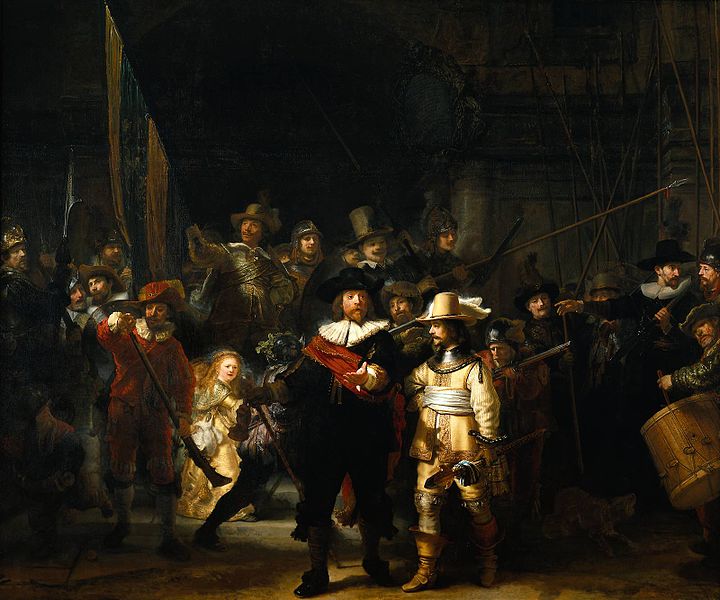
Let me illustrate with a bit of art history.

Rembrandt's 'THe Night Watch'

The image above is Rembrandt’s most famous work. It’s popularly called “The Night Watch” because its actual title is long and descriptive. Painted in 1642, The Night Watch is a scene of a militia gathered in the center of town surrounded by supporters. What few people know about The Night Watch is that it was covered with varnish sometime after Rembrandt’s death – as was the custom. Cleaned in 1940, the varnish came away and restorers discovered The Night Watch was actually a day scene! When they saw the lightened image (below) they realized that the popular title for the painting was all wrong.

The Nigh Watch (unvarnished)

Another little known fact – when The Night Watch was removed from its original location in the 1700s, the painting had to be trimmed to fit its new location. This process cut off two characters on the left side of the painting (seen below).

Night Watch trimmed

Now we know that for hundreds of years when people viewed The Night Watch, they did not see what the artist created. I believe that the same thing happens to our image of God. Our painful experiences are like dark varnish that shade and distort the way God meant for us to see him. 

How many of you have witnessed or experienced something so terrible that your concept of God no longer fits into your experience of the world? Maybe the recent school shooting in Connecticut or another world disaster or something closer to home has you wondering how God can really be good.

When something bad happens, how many of us trim God down so he can fit in our new understanding of reality? Unfortunately, when we do this, we cut off part of the story that God originally revealed to us. 

Rather than acknowledging and holding the tension between who God is and who the world portrays God to be, we allow life circumstances to distort the truth of God’s character.

Let me offer my life as an example. In the past six years I’ve experienced significant pain in circumstances both professional and personal. The past three years have been particularly difficult. What caused this pain is best kept in the confidence of my counselor and my mentors, so I’ll ask you to suspend your curiosity. Let me simply say that pain has varnished my life from sunshine to mud. Pain has distorted my image of God.The best way to illustrate this is to share a story from my days as a hospital chaplain. It’s a very difficult story to hear, but please bear with me.

One day I was working as the chaplain on call and was paged to the emergency department. There I met a young, single mother. Our staff was frantically trying to revive her four-year-old son.  During an hour of terrified waiting she told me what happened.

She and her son had been swimming in the family pool, he securely clipped in to a life jacket, she floating on a raft nearby. The grandfather came outside and the little boy said he wanted to go inside. They unhooked his life jacket and when he turned to go inside with grandpa, mom pushed off on her raft to continue relaxing. Several minutes later she decided to go check on her son and see if he had everything he needed. Only, she could not find him inside and grandpa hadn’t seen him. She raced outside and looked in the pool but didn’t see anything. (Later she told me the pool pump was broken and the water was very murky.) Thinking her son might have gone to the playground beyond their back gate, she raced there and ran around calling his name. She searched nearby and then ran back to their yard.  When she looked into the pool again, she saw a foot in the murky water of the deep end. She dove in, pulled out her son, yelled for the grandfather to call 9-1-1 and began CPR. None of the efforts of that mother or our staff saved that beautiful little boy. I lay on the floor with this devastated young mother as she wept that her child must never have gone inside, must have slipped back in the pool with her and drowned without her seeing or hearing him.

I worked many drownings when I was a chaplain. Unfortunately, few of them had happy endings. It sounds strange, but when tragedies like these are a part of your daily work, you learn methods to cope and move on to the next case. However, this drowning knocked me down. I could hardly function the next day, couldn’t bring myself to see patients, couldn’t stop the tears. I asked myself why this drowning was affecting me so personally and profoundly.

Through prayer and reflection I realized that I identified with that boy in the pool. The pool scene was my image of God. My circumstances made me feel like I was a child without a life-jacket, drowning in the murky waters of my life. Oh, I knew that God was with me like that mother was with her son in the pool, and I believed that God loved me as much as that weeping mother loved her child, but I felt like God had taken his eyes off of me and I was slipping under the water, unnoticed. Inside, my soul was crying out, “Don’t let me drown!”

Six years of painful experiences and events changed the way I saw and related to God. My image of God morphed from a loving parent to a neglectful parent who overlooked me. I had known what it was to bask in the love of my heavenly Father, but I could no longer feel the warmth of his gaze on my face.

Pain is not the end of my story. I’m walking a healing path. If you want a fuller picture of the healing in my relationship with God, listen to the sermon.  Here, I’ll simply list for you significant healing points. This is not my advice to you. It is not a step-by-step process or a self-help strategy. None of this was very intentional but was the result of a desperate desire to have my image of God and my relationship with God restored.

Lament – I embraced the biblical practice of lament and cried out to God. I took the Psalms and made their words my own when I had no words.

Prayer – I realized that my inner thoughts and prayers were sliding into a kind of un-holy and depressing complaint. I got sick of wallowing. I needed something constructive so I changed my prayer life. Prayer became an intentional time of silence where I simply acknowledged that I was in God’s presence. The only thing I ask of God is to be given consolation as I wait for things beyond my control to change.

Self-Exhortation – Sounds strange, but I reached a place where I had to confront myself. I had to ask myself the questions, “Corrie, is God negligent? Is that the truth of God’s character?” and then struggled toward the answer. It was a process of shoveling through the manure pile that was my pain and scraping through questions until I got to the bedrock of truth. I understood that I was the one who allowed my life circumstances to varnish and distort God’s image. Here is the most important question I unearthed: who is the artist of God’s image – me or God?  Put simply – who holds the paintbrush?

Sorting through Shadows and Light – Rembrandt was famous for a technique called chiaroscuro, using bold contrasts between darkness and light in a painting’s composition. Regrounding myself in the belief that God is the artist of his image and the Bible is his canvas, I’ve schooled myself to check the things the world says are true about God against what God has revealed as true. Having faith means that even when circumstances and feelings paint a bleak or dark picture in my understanding of God, I seek out the light. I find the light in the narratives of scripture.

I felt that God was a negligent parent who overlooked me in my pain, but as early as Genesis 16, the story of a downcast woman named Hagar reminds me that God is “the God who sees me.” So I focus on the light in this story, the truth of God’s character. The God I worship is one who sees the downcast, the abused, the runaways.  He is the God who finds them and who blesses them abundantly.

Waiting – I can’t tie this post up in a nice little bow for you. I have not reached ‘the other side’ of these tribulations, if there even is one. I realize that I am in control of very little that can change my circumstances, but I can shape my response to these things. I’m learning all kinds of difficult lessons about waiting, endurance and trust. I’m sure there are many blog posts to come about these.

I want to encourage you to think about ways in which painful life circumstances have varnished your image of God. Have you struggled for so long that you can no longer hold the tension between your life and your understanding of God?  Have you trimmed God down so he can fit into your understanding of the world?

If we believe scripture is the truth, then we need to see it as the canvas on which God painted his image for our viewing pleasure. If we want to be shaped by the Word and not the world, then we need to surrender the paintbrush. We need to give it back to the Master Artist. We need to gaze long and deep into God’s canvas, the Bible. We need to submit our feelings and our experiences to his story, to his revelation. Oh, what an image he creates!

If that message does not connect to your soul, then maybe it is time for you seek healing in your relationship with God. Maybe you need to look deep into your own story for the place where things went wrong and see how your image of God got stained and distorted.  Maybe it’s time to surrender the paintbrush and let the Master Artist restore his greatest work, the image of his love for you.

Return of the Prodigal Son, (detail) by Rembrandt Van Rijn

(The Return of the Prodigal Son (detail) by Rembrandt Van Rijn, 1669)